

A boiler that bangs or makes a "kettle boiling" rumble is usually overheating water in a small spot inside the heat exchanger. Water flashes to steam and the bubbles collapse with a bang. The usual causes are limescale on the heat exchanger, sludge restricting the flow, low system pressure or a slow or failing pump. Gurgling usually means air in the system, and a whistle or bang in freezing weather often points to a frozen condensate pipe. You can safely check the pressure, bleed the radiators and thaw the condensate pipe yourself. Anything inside the boiler casing is a job for a Gas Safe registered engineer.
A boiler that suddenly starts banging is unsettling, especially at 6am when the heating kicks in. Most noises have a simple cause, and some you can fix in a few minutes with a radiator key. Others are an early warning that the boiler is struggling and needs an engineer before it breaks down. For more on how your heating system works, see our complete home heating guide.
What does each boiler noise mean?
Listen carefully to the sound, and when it happens. That narrows the cause down quickly.
| Noise | What it sounds like | Most likely causes |
|---|---|---|
| Banging or thudding | Sharp knocks or bangs from the boiler or pipes, often when the heating starts | Kettling (limescale or sludge), low pressure, pipes expanding, pump problems |
| Kettling | A rumble like a kettle coming to the boil | Limescale or sludge on the heat exchanger, poor water flow |
| Gurgling or bubbling | Water trickling or bubbling in the boiler or radiators | Air in the system, low pressure, partly frozen condensate pipe |
| Whistling | A high-pitched whistle | Kettling, a blocked or frozen condensate pipe, restricted flow |
| Humming or droning | A steady hum or vibration | Pump running too fast, loose fitting, fan noise |
| Clicking that keeps going | Repeated clicking without the boiler lighting | Ignition trying and failing, often with a fault code |
| Banging in pipes when taps close | A single thud when you turn off a tap | Water hammer in the cold or hot water pipes, not the boiler itself |
If you smell gas, or the noise comes with a smell of burning, soot marks around the boiler, or a yellow or orange flame instead of blue, turn the boiler off, open the windows, don't use switches or flames, and call the National Gas Emergency number on 0800 111 999. Don't use the boiler until a Gas Safe engineer has checked it. You should have a carbon monoxide alarm near the boiler.
What is boiler kettling?
Kettling is the most common reason for a banging or rumbling boiler, and it's named after the sound a kettle makes as it comes to the boil.
Inside your boiler, water flows through a heat exchanger, where the burner heats it. If the water can't flow through fast enough, or deposits stop heat passing into the water evenly, small pockets of water get too hot. They flash into steam. The steam bubbles then collapse as they meet cooler water, and that makes the rumbling, popping or banging you hear.
The main causes of kettling are:
1. Limescale on the heat exchanger
In hard water areas, which cover much of the south and east of England, calcium and magnesium come out of the water when it's heated and build up as limescale. Scale acts like insulation, so heat doesn't pass evenly into the water and hot spots form.
Combi boilers are especially prone to scale on the hot water side, because they heat fresh mains water every time you run a tap.
2. Sludge in the heating system
Over the years, steel radiators slowly corrode inside and create a black sludge called magnetite. Sludge collects in the boiler's heat exchanger, pump and pipes, restricting the flow. Our power flush cost guide explains the signs, such as radiators that are cold at the bottom and black water when you bleed them.

3. A slow or failing pump
The pump pushes water around the system. If it's set too low, sticking or wearing out, water moves too slowly through the boiler and overheats. A failing pump can also hum, grind or vibrate.
4. Low system pressure
On a sealed system (most combi and system boilers), low pressure means less water moving through the boiler and a higher chance of hot spots and gurgling. See below for how to check it.
Is kettling dangerous?
Kettling isn't usually an immediate danger, as boilers have safety devices that shut them down if they overheat. But it's a sign the boiler is under strain. Left alone, it can damage the heat exchanger, which is one of the most expensive parts to replace, and push up your gas bill because the boiler is working harder for the same heat. Get it looked at rather than living with it.
Safe checks you can do yourself
You can do these checks without opening the boiler casing. If any step feels uncertain, stop and call an engineer.
Step 1: Check the boiler pressure
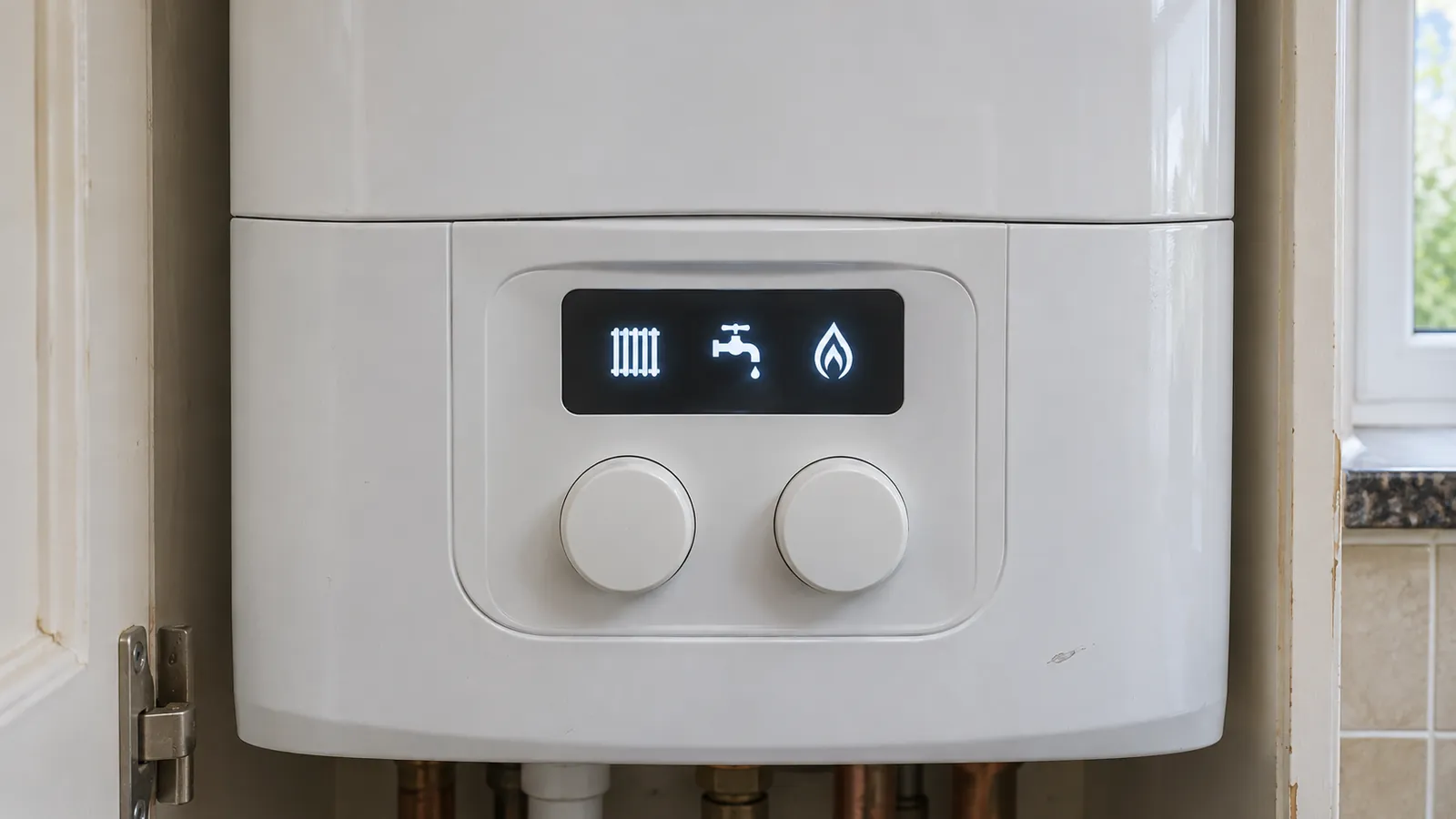
Look at the pressure gauge on the front or underneath the boiler. On most combi and system boilers it should read about 1–1.5 bar when the heating is cold, rising a little when hot. Check your boiler's manual for the exact range.
- Below about 1 bar: top it up using the filling loop. Our guide to boiler pressure shows how, step by step.
- Keeps dropping after you top it up: there's a leak or a fault with the expansion vessel. See why a combi boiler keeps losing pressure.
- Above about 2.5–3 bar when hot: the pressure is too high, often a sign of an expansion vessel problem. Don't keep topping up; call an engineer.
Step 2: Bleed your radiators
Trapped air causes gurgling and can stop water circulating properly.
- Turn the heating off and let the radiators cool.
- Put a cloth under the bleed valve at the top corner of the radiator.
- Open the valve about a quarter turn with a radiator key. You'll hear air hiss out.
- When water starts to come out steadily, close the valve.
- Do each radiator, starting with the one furthest from the boiler or on the ground floor, then upstairs.
- Check the boiler pressure again. Bleeding lets water out, so you'll often need to top it up.
Look at the water that comes out when you bleed. Black or dark brown water means sludge, which points to kettling from restricted flow. A radiator that keeps filling with air every few days can mean a leak or corrosion inside the system, which an engineer should investigate.
Step 3: Check the condensate pipe in cold weather
Modern condensing boilers have a plastic condensate pipe, usually running outside to a drain. In freezing weather it can freeze and block. The boiler may gurgle, whistle or bang as condensate backs up, and then lock out with a fault code. On Ideal boilers this often shows as L2.
To thaw it:
- Find the pipe where it leaves the wall and look for ice at bends and the open end.
- Pour warm water (not boiling) over the frozen section from a jug or watering can, or hold a hot water bottle or warm cloth against it.
- Once it's clear, reset the boiler following its manual.
Boiling water can crack the pipe, and pouring water near steps or paths can leave ice that people slip on.
Step 4: Check the thermostat and boiler settings
A very high radiator temperature setting makes kettling more likely on a scaled or sludgy system. Most modern condensing boilers run better at a lower flow temperature. Our boiler temperature guide explains the settings. Turning it down won't fix scale, but it can reduce the noise until an engineer visits.

Step 5: Rule out water hammer
If the bang happens when you turn off a tap, a washing machine fills, or a toilet cistern stops filling, the problem is probably water hammer in your water pipes, not the boiler. It happens when fast-moving water stops suddenly. A plumber can fit pipe clips, a water hammer arrestor or adjust a valve.
When you need a Gas Safe engineer
Call a Gas Safe registered engineer if:
- The banging or kettling continues after you've checked the pressure and bled the radiators
- The boiler keeps locking out, shows an overheat fault or keeps cycling on and off
- The pressure keeps dropping or climbs too high
- You hear grinding, rattling or loud humming from inside the boiler (often the pump or fan)
- Water is leaking from the boiler. See our guide to a boiler leaking water.
- The boiler is noisy and not heating properly
Never remove the boiler's front panel or try to descale or flush the heat exchanger yourself. On a gas boiler, only a Gas Safe registered engineer can legally work on gas appliances. Check an engineer's Gas Safe ID card, and that it lists the right type of work.
How engineers fix a banging boiler, and what it costs
These are rough 2026 estimates for a typical UK home. Prices vary by region, the boiler model and how much work is needed, so always ask for a written quote.
| Fix | What it involves | Estimated cost (2026) |
|---|---|---|
| Diagnostic call-out | Engineer finds the cause | about £70–£150 |
| Bleed, re-pressurise and balance | Air removed, pressure set, radiators balanced | about £70–£150 |
| Chemical descale of the heat exchanger | Descaler circulated through the boiler | about £150–£400 |
| Power flush | Whole system cleaned of sludge | about £300–£600 |
| Magnetic system filter fitted | Catches sludge before it reaches the boiler | about £100–£250 |
| Pump replaced | New circulating pump | about £200–£450 |
| Expansion vessel recharged or replaced | Restores correct pressure behaviour | about £70–£350 |
| Heat exchanger replaced | Major repair | about £400–£1,000+ |
If your boiler is over 12–15 years old and needs a new heat exchanger, get a quote for a replacement boiler too. A new boiler usually comes with a long warranty, and a heat exchanger repair on an old boiler isn't always good value. Our guide to new combi boiler costs shows typical prices.
Descale or power flush?
The two fixes treat different problems:
- Limescale (hard water, mostly on the hot water side and heat exchanger): a descale of the boiler, plus a scale reducer on the incoming mains water to stop it coming back.
- Sludge (black water, cold radiator bottoms): a chemical or power flush of the whole system, plus a magnetic filter and fresh inhibitor.
A power flush clears sludge, but it won't remove hard limescale baked onto the heat exchanger. A good engineer should tell you which one you have before recommending a fix.
How to stop your boiler banging again
Once it's fixed, these steps keep kettling away:
- Get an annual boiler service. The engineer can spot scale, sludge and pump problems early. It's also usually a condition of the manufacturer's warranty.
- Fit a magnetic filter if you don't have one, and have it cleaned at each service.
- Keep inhibitor topped up. Many engineers check inhibitor levels at the service.
- Fit a scale reducer on the mains feed to a combi in a hard water area.
- Keep the pressure right. Check the gauge every few weeks in winter.
- Insulate the condensate pipe if it runs a long way outside, and keep the end clear.
- Don't keep the flow temperature higher than you need.
If your boiler breaks down in a cold snap, a portable heater can keep one room warm while you wait for an engineer. See the cheapest electric heaters to run before you buy one.
FAQs
Why is my boiler banging when the heating comes on?
Usually kettling: limescale or sludge in the heat exchanger, or poor water flow, makes water flash to steam. Low pressure and a slow pump can cause it too. Check the pressure and bleed the radiators first, then call a Gas Safe engineer if it carries on.
Is a banging boiler dangerous?
It's not usually an immediate danger, as boilers have overheat protection. But it shows the boiler is under strain and can lead to costly damage. If you smell gas or see a yellow flame or soot, turn it off and call 0800 111 999.
Why does my boiler make a kettle noise?
That's kettling. Scale or sludge stops heat passing evenly into the water, so small amounts of water boil and the bubbles collapse noisily.
Can I descale my boiler myself?
No. Descaling a gas boiler's heat exchanger means working inside the boiler, which only a Gas Safe registered engineer should do.
Why is my boiler gurgling?
Usually air in the system or low pressure. Bleed the radiators and top up the pressure. In freezing weather, a partly frozen condensate pipe can also cause gurgling.
Why does my boiler bang when the hot water comes on?
On a combi, this often points to limescale on the hot water side of the heat exchanger, especially in hard water areas. An engineer can descale it and fit a scale reducer.
Will a power flush stop my boiler banging?
It will if the cause is sludge. It won't fix hard limescale, a failing pump or an expansion vessel fault. Ask the engineer to confirm the cause first.
How much does it cost to fix a kettling boiler?
As a rough 2026 estimate, a descale is often about £150–£400 and a power flush about £300–£600. A new heat exchanger can cost £400–£1,000 or more.
- Banging and rumbling usually means kettling: water boiling in hot spots inside the boiler.
- The main causes are limescale, sludge, low pressure and a slow pump.
- Gurgling is usually air; a whistle in freezing weather can be a frozen condensate pipe.
- You can safely check pressure, bleed radiators and thaw the condensate pipe.
- Anything inside the boiler needs a Gas Safe registered engineer.
- A magnetic filter, inhibitor, scale reducer and annual service stop it coming back.