
As a rough guide, a power flush on a typical UK central heating system costs around £300–£600 in 2026, depending mainly on how many radiators you have and how dirty the system is. A cheaper chemical or mains flush is often around £150–£350. These are estimates, so get a written quote. A flush is worth it when you have sludge symptoms: radiators cold at the bottom, a noisy boiler, black water when you bleed radiators, or before fitting a new boiler.
Over the years, the water inside your heating system picks up rust, scale and debris. This turns into a black sludge that settles at the bottom of radiators and can block pipes and the boiler. A flush cleans it out. For more on boilers, radiators and controls, see our home heating guide.
Power flush and radiator flush costs
These are typical ranges for a gas central heating system in an average UK home. Your price depends on the number of radiators, how bad the sludge is, how easy access is, and where you live.
| Job | Typical cost (estimate, 2026) | Time |
|---|---|---|
| Power flush, up to about 6 radiators | £300–£450 | About half a day to a day |
| Power flush, about 7–10 radiators | £400–£550 | About a day |
| Power flush, 11+ radiators | £500–£700+ | A day or more |
| Chemical or mains flush | £150–£350 | A few hours, plus time for chemicals to work |
| Magnetic filter fitted (on its own) | £100–£250 | One to two hours |
| Single radiator removed and flushed by an engineer | £60–£150 | About an hour |
| Inhibitor (DIY bottle) | about £15–£30 | Minutes |
Some engineers price per radiator and some charge a fixed price for the whole system. Always ask what's included: the chemicals, a magnetic filter, inhibitor at the end, and re-balancing the radiators afterwards.
What is sludge, and where does it come from?
Most central heating systems have steel radiators and copper pipes. Over time, the water inside slowly corrodes the steel and produces magnetite, a black iron oxide. In hard water areas, scale builds up too. Together with debris from installation, this makes a thick black sludge.
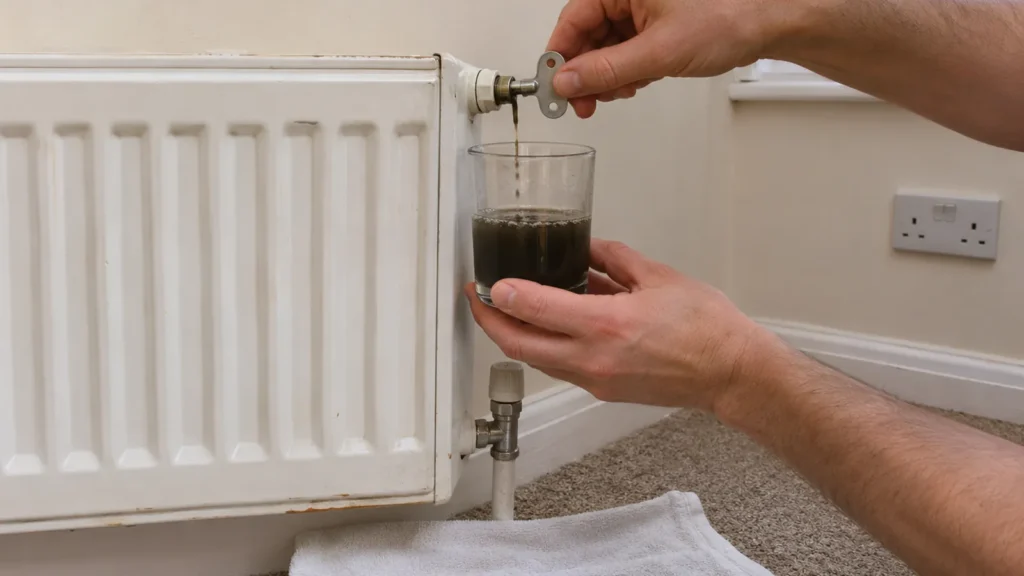
Sludge is heavier than water, so it settles at the bottom of radiators and in low points of the pipework. It can also collect in the boiler's heat exchanger and pump, where it does the most damage.
Inhibitor, a chemical added to the heating water, slows this corrosion. Many older systems have never had enough inhibitor, or it's been diluted over years of topping up.
Signs your heating system needs a flush
You probably have sludge if you notice several of these:
- Radiators are cold at the bottom but warm at the top. This is the classic sign: sludge blocks the lower part of the radiator so hot water can't flow there. (Cold at the top and warm at the bottom is different: that's usually trapped air, and you just need to bleed the radiator.)
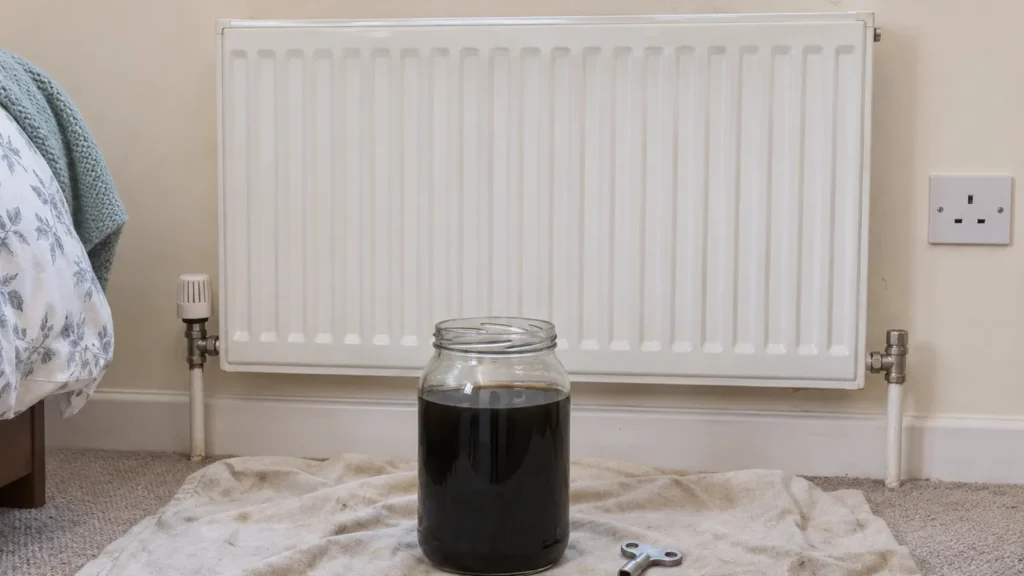
- Black or brown water comes out when you bleed a radiator
- Some radiators heat up much more slowly than others, even after balancing
- The boiler is noisy: banging, gurgling or "kettling" sounds when it heats up
- The boiler keeps locking out with overheating or circulation faults
- The heating takes longer to warm the house than it used to
- You keep bleeding radiators and they fill with air or gas again
- Pinhole leaks in old radiators (corrosion from the inside)
Kettling and repeated overheating faults can also come from other problems inside the boiler, such as scale in the heat exchanger or a failing pump. Don't open the boiler casing. A Gas Safe registered engineer can diagnose it. Smell gas? Call 0800 111 999.
A simple test for sludge
- With the heating off and cooled down, hold a white cloth or a glass under a radiator's bleed valve.
- Open the valve a quarter turn with a radiator key and let a little water run into the glass.
- Close the valve.
Clear or slightly cloudy water is fine. Black, dark brown or inky water means magnetite sludge. If you hold a small magnet against the outside of the glass and the dark particles move towards it, it's magnetite.
On a sealed (combi or system boiler) system, check the boiler pressure afterwards and top it up if it has dropped.
Power flush vs chemical flush vs mains flush
There are three common ways to clean a heating system. They differ in how strong they are and what they cost.
| Method | How it works | Best for | Downsides |
|---|---|---|---|
| Power flush | A pump pushes water and cleaning chemicals through the system at high flow, reversing direction, often radiator by radiator | Heavy sludge, before a new boiler on a dirty system | Costs more; can expose weak joints in very old systems |
| Chemical flush | A cleaning chemical is added and circulated by your own boiler pump for a set time, then drained and refilled | Light to moderate sludge, routine cleaning | Less powerful; needs a drain-down |
| Mains flush | Mains water pressure is used to push water through each radiator and pipe in turn | Modern systems, light debris, some newer boilers | Less effective on heavy sludge |
Many installers combine a chemical clean with a power or mains flush, then fit a magnetic filter and add inhibitor at the end. That combination usually gives the best long-term result.
Is a power flush always the best option?
Not always. A power flush is strong, so on a very old system with tired radiators, joints or pipes, it can uncover weak spots that were only being held together by sludge. Leaks can appear after the flush. A good engineer checks the system first and tells you if there's a risk.
Some systems, especially those with very narrow microbore pipes (around 8–10mm), can be harder to power flush effectively. Your engineer may suggest a different method.
When a flush is worth it
A flush usually makes sense when:
- You're fitting a new boiler. Most manufacturers expect the system to be cleaned, and it may affect your warranty. See what a new combi boiler costs.
- Several radiators are cold at the bottom and the bleed water is black.
- Your engineer has found sludge in the filter, pump or heat exchanger.
- The boiler keeps locking out with circulation or overheating faults, and sludge is the likely cause.
When a flush probably isn't worth it
- Only one radiator is cold at the bottom. Flushing that single radiator yourself, or asking an engineer to do just that one, is much cheaper.
- Radiators are cold at the top. That's air: bleed them.
- The boiler is very old and due for replacement soon. It may make more sense to clean the system as part of the new installation.
- The system was cleaned recently, already has a magnetic filter and the bleed water runs clear.
- The real problem is a faulty part, such as a diverter valve or pump. An engineer's diagnosis comes first.
How to flush a single radiator yourself
If one radiator is cold at the bottom, you can often take it off the wall and flush it out with a hose. It's a messy job but not a difficult one. Allow an hour or two.
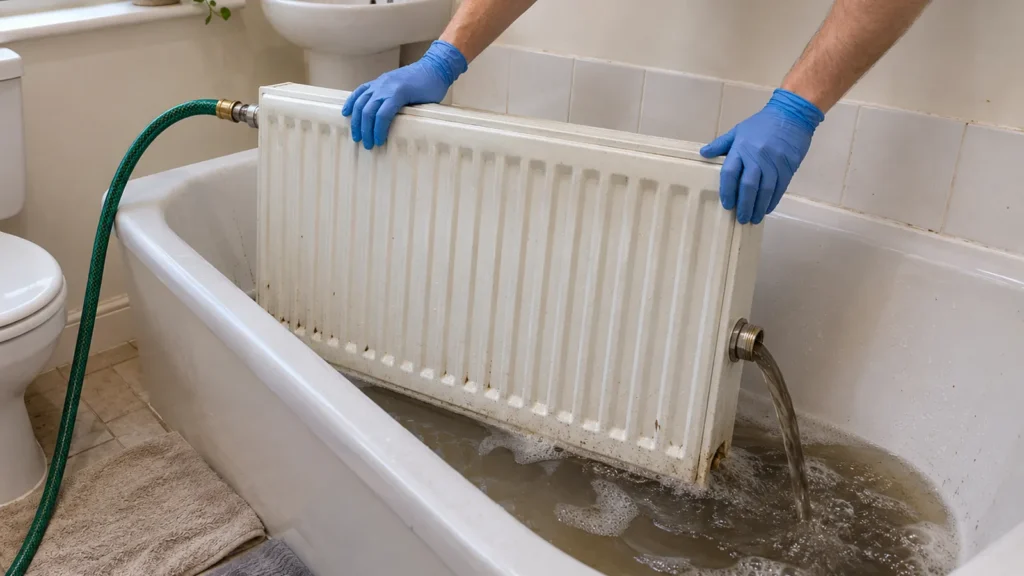
This is a radiator job, not a boiler job. Don't touch the boiler, its casing or any gas pipe. If you're not confident, or the valves are seized, ask a heating engineer. Radiators are heavy and full of dirty water, so get someone to help you lift it.
You'll need: a radiator key, two adjustable spanners, old towels or dust sheets, a shallow tray or roasting tin, a bucket, PTFE tape, a garden hose, and inhibitor.
- Turn the heating off and let the whole system cool down completely.
- Lay towels down and place the tray under the valve at one end.
- Close both radiator valves. Turn the thermostatic valve (TRV) to 0 or off. Take the cap off the lockshield valve at the other end and close it with a spanner. Count the number of turns so you can open it back to the same position later, which keeps the system balanced.
- Loosen the nut between one valve and the radiator. Water will start to come out, so catch it in the tray and empty it into the bucket.
- Open the bleed valve with the radiator key to let the water drain faster.
- When it's drained, undo the nut at the other end as well. Lift the radiator off its brackets, keeping the outlets pointing up, and carry it outside.
- Flush it with the hose. Push the hose into one outlet and run water through until it comes out clear. Tip it, turn it over and repeat from the other end.
- Refit the radiator on its brackets. Wrap a little PTFE tape around the valve tail threads if needed, then tighten the nuts.
- Open the TRV and the lockshield (the same number of turns as before).
- Refill and bleed: on a sealed system, top up the pressure with the filling loop to about 1–1.5 bar, then bleed the radiator until water comes out. On an open-vented system with a tank in the loft, the system refills itself.
- Check for leaks at both valves, then turn the heating back on and bleed again once it's warm.
Add inhibitor afterwards
Draining water out dilutes the inhibitor. Adding fresh inhibitor helps slow new corrosion.
- Sealed system (combi or system boiler): inhibitor is usually added through a radiator bleed valve with a special injector, or through a magnetic filter. Follow the product's instructions.
- Open-vented system: add it to the small feed and expansion tank in the loft.
If the pressure on a sealed system keeps dropping after you've refitted a radiator, check the valve joints with a dry tissue for a slow drip. Our guide to a combi boiler losing pressure covers the other causes.
Keeping sludge away after a flush
- Fit a magnetic filter on the return pipe to the boiler, and get it cleaned at every annual service.
- Keep inhibitor topped up. Many engineers test inhibitor levels at the service.
- Fix leaks quickly. Every top-up brings in fresh oxygen, which speeds up corrosion.
- Book an annual boiler service with a Gas Safe registered engineer.
- Bleed radiators when they're cold at the top, and note whether the water is clear.
Will a flush lower my heating bills?
A flush can help radiators heat up fully again, so rooms warm faster and the boiler may not need to run as long. How much difference it makes depends on how bad the sludge was. Don't expect a big saving if the system was already fairly clean.
The cheapest heat is the heat you don't lose. Before spending on your heating, check the basics like draught-proofing and loft insulation in our insulation and EPC guide. You can also check whether a room's radiator is big enough with our radiator BTU calculator.
FAQs
How much does a power flush cost for 10 radiators?
As a rough estimate, a power flush for about 10 radiators often costs around £400–£550 in 2026. The price depends on how dirty the system is and on local labour rates.
How long does a power flush take?
Usually about half a day to a full day for a typical house. Larger or very dirty systems can take longer.
How often should you power flush central heating?
There's no fixed schedule. Many systems never need one if they have a magnetic filter, enough inhibitor and an annual service. Flush when there are clear signs of sludge, or when a new boiler is fitted.
Can a power flush cause leaks?
It can on a very old system, because the strong flow can reveal weak joints or corroded radiators that sludge had been sealing. A good engineer checks the system first and explains the risk.
Why is my radiator cold at the bottom?
Usually sludge has settled in the bottom of the radiator, stopping hot water from flowing there. Flushing that radiator, or the whole system, normally fixes it.
Why is my radiator cold at the top?
That's trapped air. Bleed the radiator with a radiator key until water comes out, then check your boiler pressure.
Can I power flush my own system?
Hiring a power flush machine is possible, but it's a big job with chemicals and dirty water, and it's easy to get wrong. Flushing a single radiator with a hose is a reasonable DIY job; a full system flush is usually best left to a heating engineer.
Is a chemical flush as good as a power flush?
For light sludge, a chemical flush can work well and costs less. For heavy sludge, a power flush is stronger. Many engineers combine the two.
- Typical 2026 estimate: about £300–£600 for a power flush, £150–£350 for a chemical or mains flush.
- Radiators cold at the bottom plus black bleed water are the main signs of sludge.
- Cold at the top is air, not sludge: bleed the radiator.
- One cold radiator? Flush just that one; it's much cheaper.
- A magnetic filter, inhibitor and an annual service keep sludge away.