

As a rough guide, a like-for-like combi boiler swap in a typical UK home costs around £2,000–£3,500 fitted in 2026, depending on the boiler, its output and how much pipework changes. Converting from a system or regular boiler (with a hot water cylinder and loft tanks) to a combi usually costs more, often around £3,000–£5,000 or above, because of the extra work. These are estimates. Get at least three written quotes from Gas Safe registered engineers for your own home.
A new boiler is one of the biggest bills most homeowners face, and the prices you see online vary a lot. For everything else to do with boilers, radiators and controls, see our home heating guide.
New combi boiler cost: quick estimates
These are typical ranges for a gas combi boiler, supplied and fitted, in an average UK home. Prices vary by region, by installer and by how much work your home needs.
| Type of job | Typical cost (estimate, 2026) | What it usually involves |
|---|---|---|
| Combi to combi, same place | £2,000–£3,500 | Remove old combi, fit new one, flush, filter, controls |
| Combi to combi, moved location | £2,500–£4,500 | As above, plus new gas, water, flue and condensate runs |
| System or regular to combi | £3,000–£5,000+ | Remove cylinder and loft tanks, re-pipe, cap old pipes |
| Back boiler to combi | £3,500–£6,000+ | Remove old back boiler and fire, more building work |
The boiler itself is often only around half of the total. Labour, parts, the flue, the filter, the controls and disposal of the old boiler make up the rest, so a "cheap boiler" advert is rarely the whole price.
What affects the price of a new combi boiler?
1. The boiler model and brand
Combis range from budget models to premium ones with longer warranties and better controls. A higher price doesn't always mean a better boiler for your home. What matters most is that it's the right size, it's installed well, and it's serviced every year.
2. The output (kW)
Combi boilers are sized by how much hot water you need at once, not just by the size of your house. Common sizes are around 24–35kW.
| Home | Typical combi output | Notes |
|---|---|---|
| 1–2 bed flat, one bathroom | about 24–28kW | One shower at a time |
| 2–3 bed house, one bathroom | about 28–30kW | The most common size |
| 3–4 bed house, bath plus en-suite | about 30–35kW | Combis struggle with two showers at once |
A bigger combi costs a little more and, if it's oversized for your heating, can waste gas by cycling on and off. A good installer will check your mains water flow and pressure before recommending a size, because a combi can only deliver as much hot water as your incoming mains allows.
If you have two or more bathrooms that are used at the same time, a combi may not be the best choice even at 35kW. Ask about a system boiler with a cylinder, or a storage combi, before you commit.
3. Like-for-like swap vs a conversion
This is the biggest single price factor.
- Combi to combi: the gas, water and heating pipes are already in roughly the right place. The job usually takes one to two days.
- System boiler to combi: the hot water cylinder comes out, and the pipework is changed so hot water comes straight from the boiler.
- Regular (heat-only) boiler to combi: as above, plus the cold water tank and the feed and expansion tank in the loft are removed, and the heating system is converted to a sealed, pressurised system.
Converting an old open-vented system to a sealed combi system puts the pipes and radiators under more pressure than before. Weak joints or old radiators can start to leak after the change, so a good installer will check them first and may suggest replacing some.
4. Moving the boiler
Moving the boiler, for example from a kitchen cupboard into a loft or utility room, adds new gas pipe, water pipes, a new flue position and a new condensate route. Expect it to add several hundred pounds, or more if it involves lifting floors or a long gas run.
5. Gas pipe upgrade
A combi burns a lot of gas when it heats water. Many older homes have a gas pipe that's too narrow for a modern combi, often 15mm, when a 22mm supply from the meter is commonly needed. The engineer must check the gas supply can deliver enough at the boiler. Upgrading the pipe is a common extra on conversions.
6. Flue
Every condensing boiler needs a flue that meets current rules on position and distance from windows, doors and boundaries. If the old flue position isn't allowed any more, or you need a vertical flue through the roof or a long flue kit, the cost goes up.

7. Condensate pipe
Condensing boilers produce acidic water that runs to a drain through a plastic condensate pipe. If it runs outside, it should be wide enough and insulated so it doesn't freeze in a cold snap, which is one of the most common winter breakdowns. Ask your installer how they'll route it.
What should a new combi boiler quote include?
A fair quote should list everything in writing. Check it covers:
- The exact boiler make, model and output (kW)
- Removal and disposal of the old boiler (and cylinder and tanks, if converting)
- A system clean: at least a chemical flush, and a power flush if the system is dirty
- A magnetic system filter fitted on the return pipe to catch sludge
- Inhibitor added to the system water to slow down corrosion
- Controls: a programmer or room thermostat meeting current rules (see below)
- The flue kit and the condensate route
- Any gas pipe upgrade needed
- Thermostatic radiator valves (TRVs) if any are missing
- Commissioning, the benchmark checklist and building regulations notification
- Warranty registration and what servicing it needs
- VAT: is it included?
A quote that's much cheaper than the others often leaves out the flush, the filter or the controls. Those are the things that protect the new boiler and keep the warranty valid, so compare quotes line by line, not just on the final number.
Magnetic filters, flushing and inhibitor
Most boiler manufacturers expect the heating system to be cleaned when a new boiler goes in, and many expect a magnetic filter too, as a condition of a longer warranty. Sludge left in old pipes and radiators can block the new boiler's heat exchanger.

- Flush: removes sludge and debris from the old system. See our guide to power flush and radiator flush costs.
- Magnetic filter: catches the black iron sludge (magnetite) before it reaches the boiler. It needs cleaning at each annual service.
- Inhibitor: a chemical added to the water to reduce corrosion inside radiators and pipes.
Smart controls and the rules in England
In England, the Boiler Plus rules (in force since April 2018) mean a new gas boiler must be at least 92% efficient (ErP) and come with time and temperature controls. A replacement combi also needs at least one of these extra energy-saving measures:
- weather compensation
- load compensation
- a smart thermostat with automation and optimisation functions
- flue gas heat recovery
Your installer will tell you which option they're including. Rules differ in Scotland, Wales and Northern Ireland, so ask your installer what applies where you live.
A smart thermostat can add cost, but a simple compliant thermostat is often included. You don't have to choose the most expensive smart system to meet the rules.
Building regulations: notification and certificates
Fitting a new boiler is notifiable building work. You don't need to contact your council yourself if you use a Gas Safe registered engineer, because they can self-certify the job.
After the installation:
- The engineer notifies Gas Safe Register that the work is done.
- You should receive a Building Regulations Compliance Certificate, usually by post, a few weeks later.
- You should also get the benchmark checklist filled in, and the boiler's warranty registered.
Keep these documents. You'll need them when you sell the house, and the warranty may depend on them.
Only a Gas Safe registered engineer can legally install a gas boiler. Check the engineer's Gas Safe ID card, and check they're registered for the type of work, on the Gas Safe Register website before work starts. Smell gas at any time? Call the National Gas Emergency number on 0800 111 999.
Boiler warranties: what to check
New boilers usually come with a manufacturer's warranty, often anywhere from a few years up to ten or more, depending on the brand, the model and the installer. Before you choose, check:
- How long is it, and is it parts and labour?
- Does it need registering? (Most do, within a set time.)
- Does it need a filter and an annual service? Missing a service can void it.
- Who do you call if it breaks? The manufacturer or the installer?
A long warranty is valuable, but only if you keep up the annual service it requires.
How to get the best price: three quotes
- Get at least three written quotes from Gas Safe registered engineers. Local independents are often cheaper than national fixed-price websites, but not always.
- Ask each one to visit, or at least do a proper video survey. A quote without checking your gas pipe, flue and water pressure is a guess.
- Give everyone the same brief: same location, same type of boiler, same extras. Then you can compare like for like.
- Compare line by line: boiler model and kW, flush type, filter, controls, warranty length, VAT.
- Check reviews and the Gas Safe ID. Ask how long the job will take and who will actually do it.
- Avoid peak winter if you can. Engineers are busiest from November to February. Booking a planned replacement in spring or summer can make it easier to get a good slot.
Paying monthly: be careful with finance
Many installers offer finance to spread the cost. It can help, but:
- Check the APR and the total amount repayable, not just the monthly figure.
- "0% finance" deals may carry a higher boiler price, so compare the cash price too.
- Be wary of "pay monthly, no credit checks" offers. Read the terms carefully: these can be very expensive overall.
- Finance should be from a provider regulated by the Financial Conduct Authority (FCA).
If you're struggling to afford a replacement, check the grants section below before taking on debt.
Repair or replace? When a new boiler makes sense
A breakdown doesn't automatically mean you need a new boiler. Many faults, such as low boiler pressure, a boiler losing pressure or a reset lockout, are fixable for far less.
Replacement is usually worth considering when:
- The boiler is roughly 15 years old or more and breaking down more often
- A major part has failed, such as the heat exchanger, and the repair is a big share of the cost of a new boiler
- Parts are no longer available for your model
- It's a non-condensing boiler, which is much less efficient than a modern condensing one
- Your engineer has flagged a safety problem or "at risk" status
- You're changing the house anyway, for example a new kitchen or loft conversion
A rough rule many engineers use: if a single repair costs more than around a third to a half of a new boiler, and the boiler is old, replacement often makes more sense. Ask for a written diagnosis before you decide.
A new boiler on its own doesn't fix a cold, draughty house. Insulation and draught-proofing reduce how hard any boiler has to work. See our insulation and EPC guide for the cheapest improvements first.
Are there grants for a new boiler?
Help with a new gas boiler is limited and changes often, so always check the latest rules on gov.uk and with your energy supplier.
- Energy supplier schemes (ECO4): low-income and vulnerable households, or those on certain benefits, have sometimes been able to get a broken or very inefficient boiler replaced through ECO4. It is due to end on 31 December 2026, with the government's Warm Homes Plan set to bring new support. Check what's open now.
- Boiler Upgrade Scheme: this gives grants towards heat pumps and biomass boilers in England and Wales (£7,500 towards an air source or ground source heat pump in 2026), not new gas boilers. Check the current amount on gov.uk before you plan.
- Local council help: some councils run their own schemes for older, disabled or low-income residents, including disabled facilities grants for adaptations. Ask your council.
Be wary of cold callers offering "free government boilers". Check any scheme on gov.uk or with your energy supplier before you give out personal details.
Combi, system or something else?
A combi suits most smaller homes with one bathroom: no tanks, hot water on demand, and less space used. A system boiler with a cylinder often suits homes with two or more bathrooms in use at the same time. If you're planning to switch to a heat pump in the next few years, ask your installer whether it makes sense to keep your hot water cylinder space now.
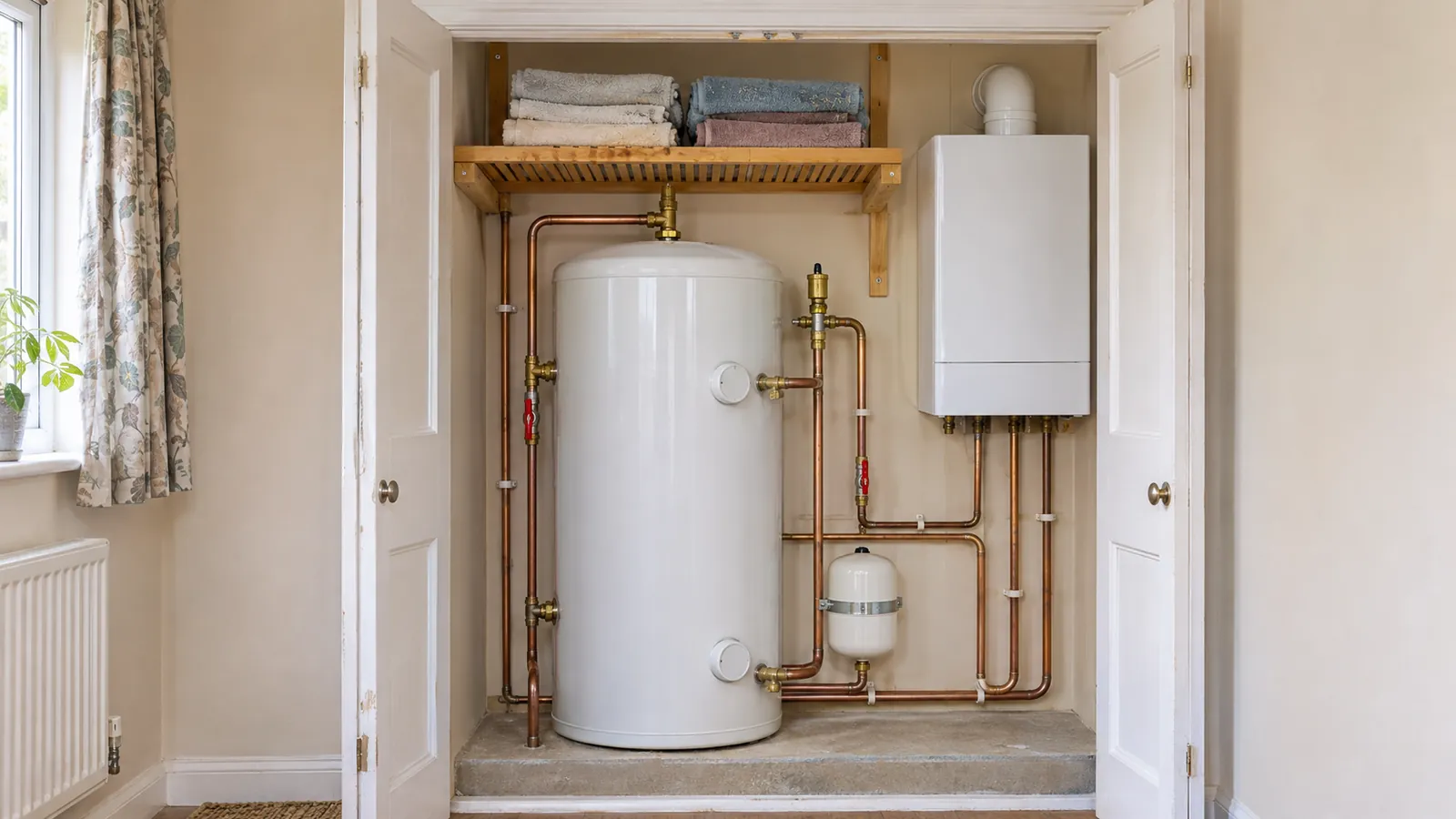
Not sure what you have? Look for a hot water cylinder (usually in an airing cupboard) and tanks in the loft. No cylinder and no tanks usually means a combi.
You can also check what size radiators each room needs with our free radiator BTU calculator, which is useful if you're replacing radiators at the same time.
No mains gas? Our guide to electric boilers compares running costs with gas at today's price cap rates.
FAQs
How much does a new combi boiler cost for a 3 bed house?
As a rough estimate, a like-for-like combi swap in a 3 bed house is often around £2,000–£3,500 fitted in 2026. A conversion from a system or regular boiler usually costs more. Your own quotes will depend on the boiler, the output and the work needed.
How long does it take to fit a new combi boiler?
A straight combi swap usually takes one to two days. A conversion from a system or regular boiler, or moving the boiler to a new place, can take two to four days.
Is it cheaper to replace a combi with a combi?
Yes, usually. The gas, water and heating pipes are already in place, so there's less labour and fewer parts than a conversion or a move.
Do I need a power flush with a new boiler?
Most manufacturers expect the system to be cleaned when a new boiler is fitted. Whether it's a chemical flush or a full power flush depends on how dirty the system is. Ask your installer what they recommend and why.
Can I fit a combi boiler myself?
No. In the UK, gas boiler installation must be done by a Gas Safe registered engineer. It's illegal and dangerous for an unregistered person to do gas work.
What size combi boiler do I need?
Most UK homes use a combi of about 24–35kW. The right size depends on how much hot water you need at once and on your mains water flow, more than on the number of rooms. A good installer measures your water flow before recommending one.
Is there a ban on new gas boilers?
At the time of writing, there's no ban on replacing a gas boiler in an existing home. New-build rules are moving away from gas, so check gov.uk for the latest position before you choose.
Will a new boiler lower my energy bills?
Replacing an old non-condensing boiler with a modern condensing combi usually uses less gas for the same heat. How much you save depends on your old boiler, your home and how you use your heating.
- Typical 2026 estimate: about £2,000–£3,500 for a combi-to-combi swap, more for a conversion.
- The biggest price factors are conversion vs swap, moving the boiler, the gas pipe and the flue.
- A fair quote lists the boiler, flush, filter, controls, warranty and building regs notification.
- Get three written quotes from Gas Safe registered engineers and compare them line by line.
- Check finance terms carefully, and check gov.uk for any grants before you pay.