Most combi and system boilers should read between 1 and 1.5 bar when the heating is off and the boiler is cold. It's normal for pressure to rise to around 2 bar when the heating is running. Below about 1 bar, many boilers stop working and show a low-pressure fault. Above about 2.5–3 bar, the safety valve may start releasing water. Check your boiler's manual for its exact range.
Low boiler pressure is one of the most common reasons for "no heating, no hot water" in UK homes, and it's one of the few boiler problems you can usually fix yourself, safely, in five minutes. For other boiler problems see our home heating guide.
Normal boiler pressure: quick reference
| Gauge reading | What it means | What to do |
|---|---|---|
| Below 0.5 bar | Too low; the boiler will usually lock out | Top up to 1–1.5 bar, then look for the cause |
| 0.5–1 bar | Low | Top up when the boiler is cold |
| 1–1.5 bar (cold) | ✅ Normal | Nothing |
| 1.5–2 bar (heating on) | ✅ Normal when hot | Nothing |
| 2.5 bar+ | Too high | Bleed a radiator to bring it down (see below) |
| 3 bar | The pressure relief valve will open and dump water outside | Reduce pressure; call an engineer if it keeps happening |
Many gauges have a green zone or a red marker needle. Check the pressure with the boiler cold (heating off for an hour) because that's what the manufacturer's figure refers to.
Where to find the pressure gauge
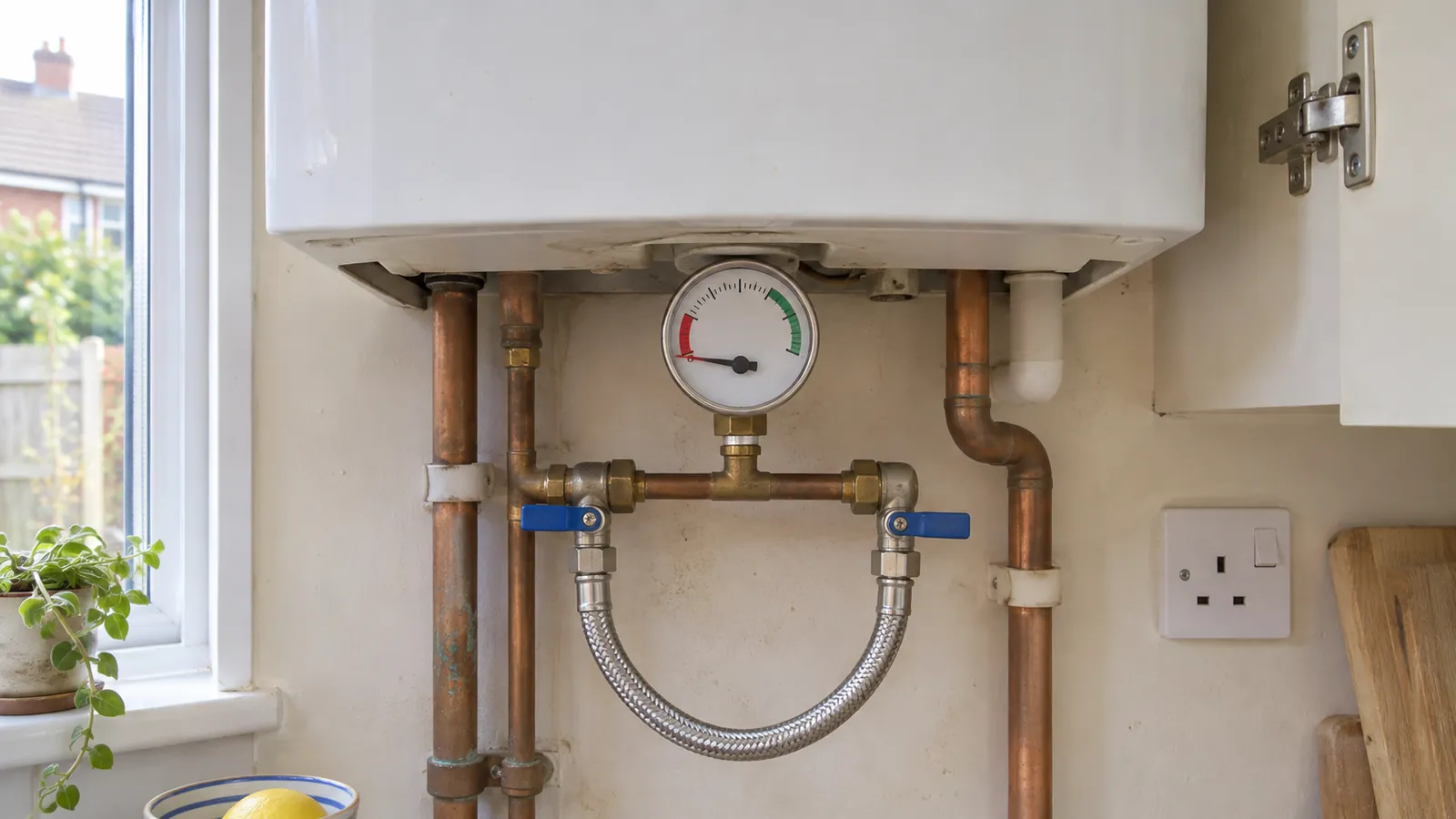
- Dial gauge: a round gauge on the front or underneath the boiler, marked in bar, often with a green section.
- Digital display: many newer boilers (e.g. Worcester Bosch Greenstar, Ideal Logic, Vaillant ecoTEC) show the pressure on the screen, sometimes only after you press a button. Your user manual shows how.
Only sealed systems have a pressure gauge. If you have a conventional (regular) boiler with a water tank in the loft, it works differently and doesn't need topping up this way.
How to top up boiler pressure (filling loop)
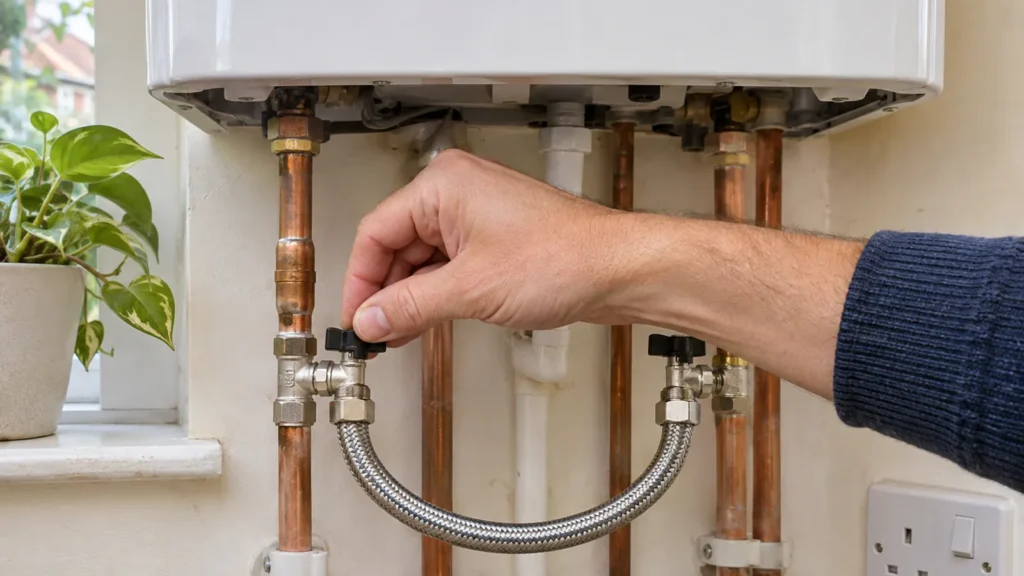
Most combi boilers are topped up using a filling loop: a short flexible hose with a valve at each end (or an integral key or lever underneath the boiler) that lets mains water into the heating system.
- Turn the heating off and let the boiler cool down so you get an accurate reading.
- Find the filling loop. It's usually under the boiler: either a silver braided hose between two valves, or a built-in lever, key or blue tap. Check your manual if you can't see it.
- If the hose is detachable, attach both ends securely, hand-tight.
- Open the valves slowly, one fully and then the other gradually. You'll hear water flowing in.
- Watch the gauge and close the valves as soon as it reaches about 1.2–1.5 bar.
- Close both valves firmly. If you have a detachable hose, remove it and keep it safe (a small drip of water is normal).
- Reset the boiler if it's showing a fault code, then turn the heating back on.
Topping up the pressure with the filling loop is a normal householder job. Don't remove the boiler casing or try to adjust anything inside the boiler. If the boiler still shows a fault after topping up and resetting, or you smell gas (call 0800 111 999), contact a Gas Safe registered engineer.
What if the boiler pressure is too high?
High pressure usually means too much water went in while topping up, or the filling loop valve is letting water through.
- Turn the heating off and let the system cool.
- Check both filling loop valves are fully closed.
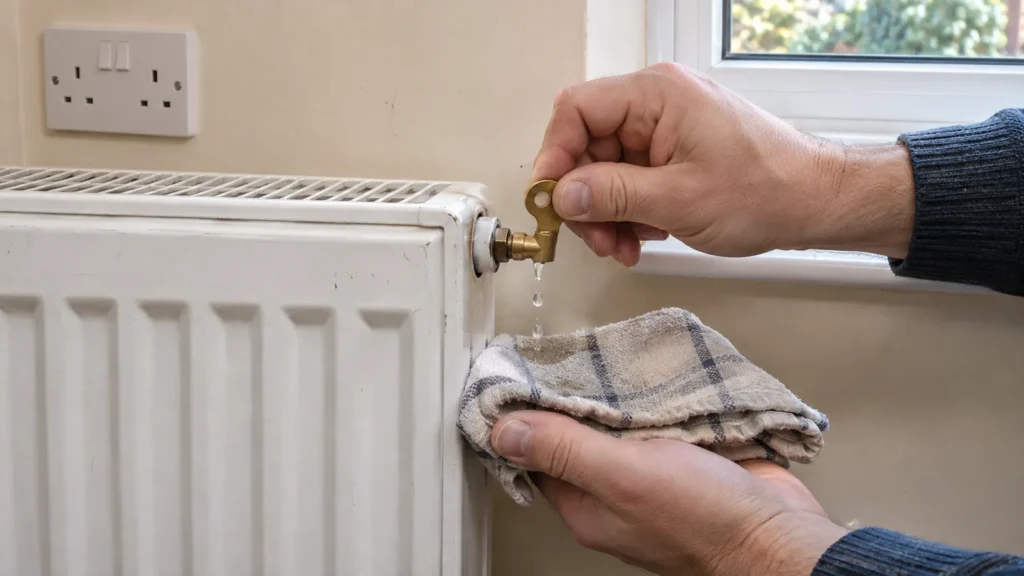
- Bleed a radiator: hold a cloth under the bleed valve and open it with a radiator key until water (not just air) comes out. Close it when the gauge reads about 1.5 bar.
- If the pressure climbs back up on its own, or shoots up when the heating runs and then drops, the filling loop valve or the expansion vessel may be faulty. That's a job for a heating engineer.
Why is my boiler pressure rising to 3 bar?
If the gauge climbs towards 3 bar when the heating is on, then drops back when it cools, the expansion vessel has usually lost its air charge and can no longer absorb the extra volume of hot water. At about 3 bar the pressure relief valve opens and releases water through the copper pipe outside, so you end up topping up again later.
Other causes of pressure creeping up:
- The filling loop is letting water in. Check both valves are fully closed; a worn valve can let mains water seep in slowly.
- You topped up while the system was hot, then it rose further.
- On some combis, a faulty plate heat exchanger can let mains water into the heating side. That's an engineer job.
A reading of 2.5 bar when hot is on the high side but not an emergency. Anything that regularly reaches 3 bar needs an engineer to check the expansion vessel.
Worcester boiler pressure
Worcester Bosch instructions for models such as the Greenstar 4000 say to fill to roughly 1–1.5 bar (check your model's manual). Many Greenstar models show the pressure on a dial on the front or underneath; newer 4000 and 8000 models show it digitally.
- Older Greenstar i/Si/Ri: usually a key-operated filling link underneath. The key is often clipped under the boiler or kept with the manual.
- Newer models: a keyless filling link, which is a lever or tap underneath.
- No key? Don't force it. Replacement keys are cheap, or there may be an external braided filling loop on the pipes below.
See also: how to reset a Worcester boiler.
Ideal boiler pressure
Ideal recommends a cold pressure of about 1–1.5 bar on most Logic and Vogue models. Low pressure on an Ideal boiler usually shows as an F1 fault code. Ideal combis normally have a built-in filling loop with a lever or key underneath, or an external braided hose. Top up to around 1.5 bar, then press reset.
Vaillant and Baxi boiler pressure
- Vaillant says the gauge should generally read 1–1.5 bar (and to avoid going above 2.5 bar); low pressure shows as F22 (fix F22).
- Baxi boilers typically run at 1–1.5 bar cold; high pressure on a Baxi is usually the same expansion vessel issue described above.
Why does boiler pressure drop?
A small drop over months is normal. If you're topping up every week or two, something's causing it. The most common reasons:
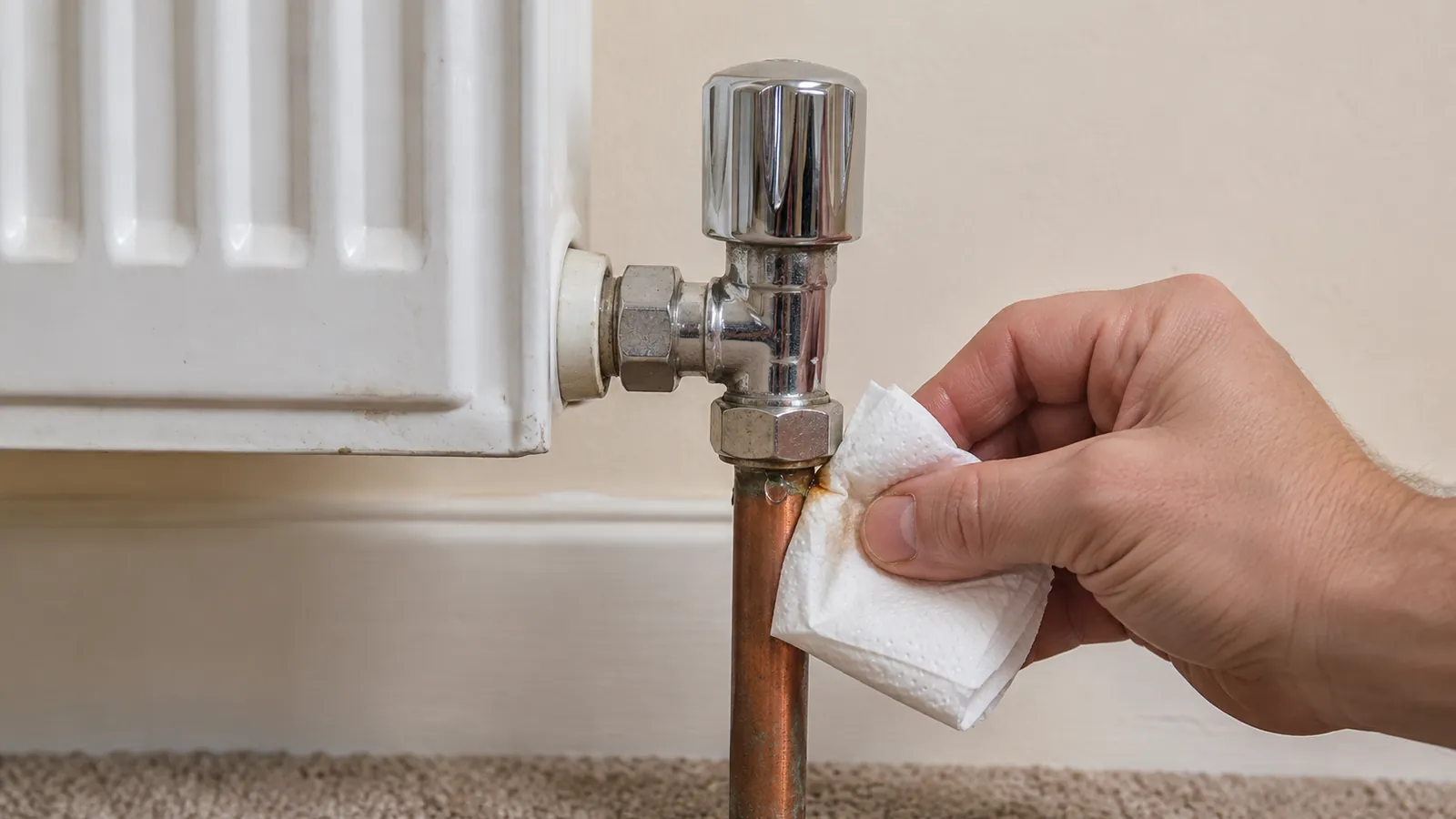
- Water leaking from a radiator, valve, pipe joint or the boiler itself
- Bleeding radiators (this lets water out with the air)
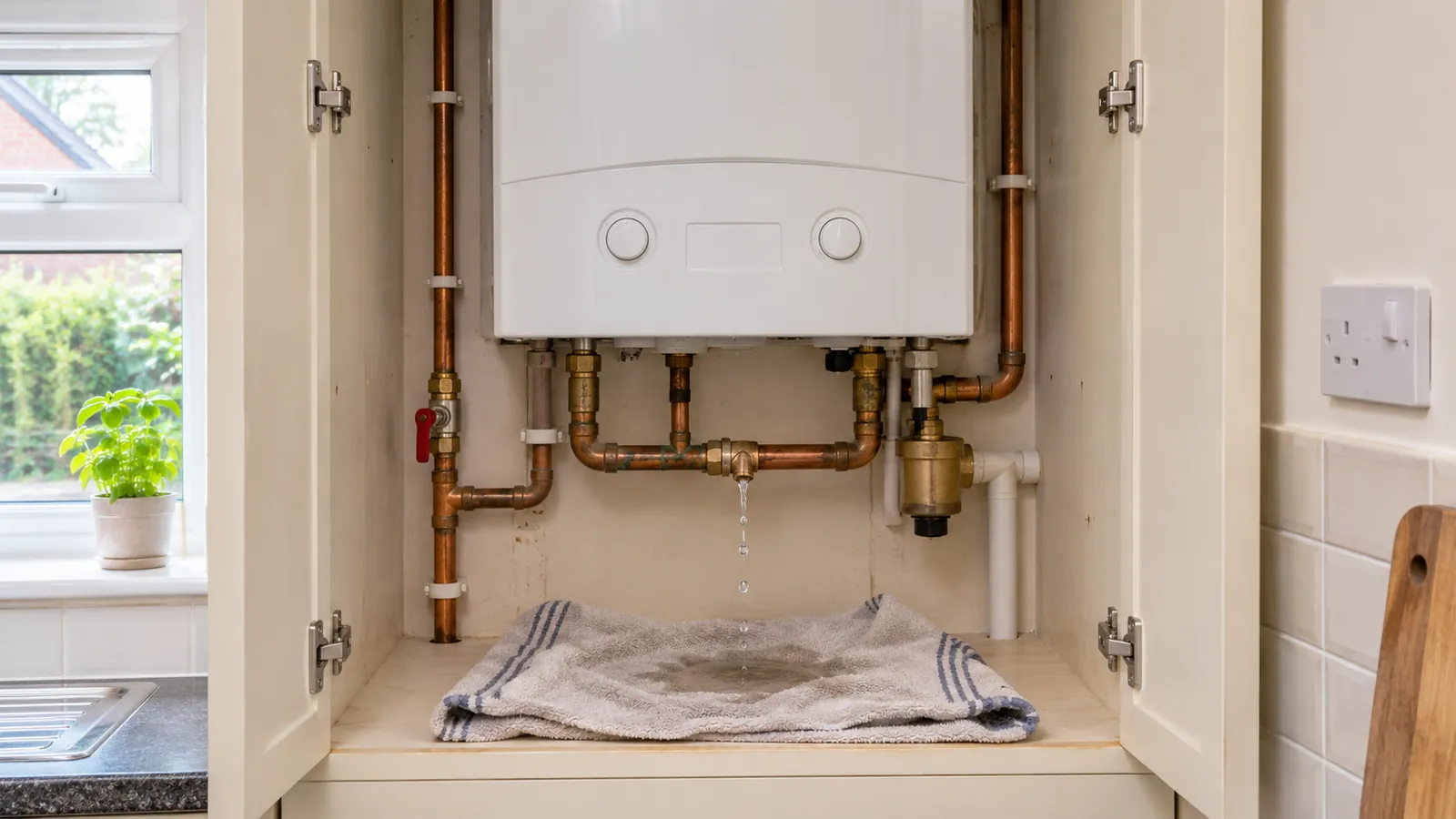
- A pressure relief valve that's letting water out through the copper pipe outside
- A faulty expansion vessel
We cover each cause and what to check in combi boiler losing pressure.
FAQs
What should combi boiler pressure be when the heating is on?
Around 1.5 to 2 bar is normal when the system is hot. Pressure rises as water heats up and expands, then falls back as it cools.
Is 2 bar too high for a boiler?
Not when the heating is running: up to about 2 bar is normal when hot. If it reads 2 bar or more when the boiler is cold, it's a little high; bleed a radiator to bring it back to 1–1.5 bar.
Is low boiler pressure dangerous?
No. Low pressure isn't dangerous, it's a safety feature: the boiler shuts down to protect itself. You just won't have heating or hot water until it's topped up.
Is high boiler pressure dangerous?
Boilers have a pressure relief valve that opens at about 3 bar to release water safely, so it isn't usually dangerous, but it shouldn't keep happening. Reduce the pressure and get an engineer to check if it recurs.
Is 2.5 bar too high for a boiler?
When the heating is running, 2.5 bar is high but usually safe because the relief valve opens at 3 bar. When the boiler is cold, 2.5 bar is too high: bleed a radiator to bring it down to about 1.5 bar.
What pressure should an Ideal boiler be?
About 1–1.5 bar when cold on most Ideal Logic and Vogue models. Low pressure on an Ideal boiler usually shows as an F1 fault.
How do I increase pressure on a Worcester boiler without a key?
Newer Worcester models have a keyless filling lever underneath. Older Greenstar models need the filling key, which is often clipped under the boiler; replacement keys are inexpensive. Don't force the filling link open with tools.
How do I check my boiler pressure?
Look for a round gauge on the front or underneath the boiler, or a pressure reading on the digital display. Check it when the heating has been off for a while, so you get the cold reading.
Why does my boiler pressure go up when the heating is on?
Water expands as it heats. The expansion vessel normally absorbs this. A small rise (up to about 2 bar) is normal; a big jump towards 3 bar suggests the expansion vessel needs re-pressurising by an engineer.
- Normal boiler pressure is 1–1.5 bar cold, up to about 2 bar hot.
- Top up with the filling loop with the boiler cold, and stop at 1.2–1.5 bar.
- Too high? Bleed a radiator.
- Topping up often means a leak or faulty part: find the cause.