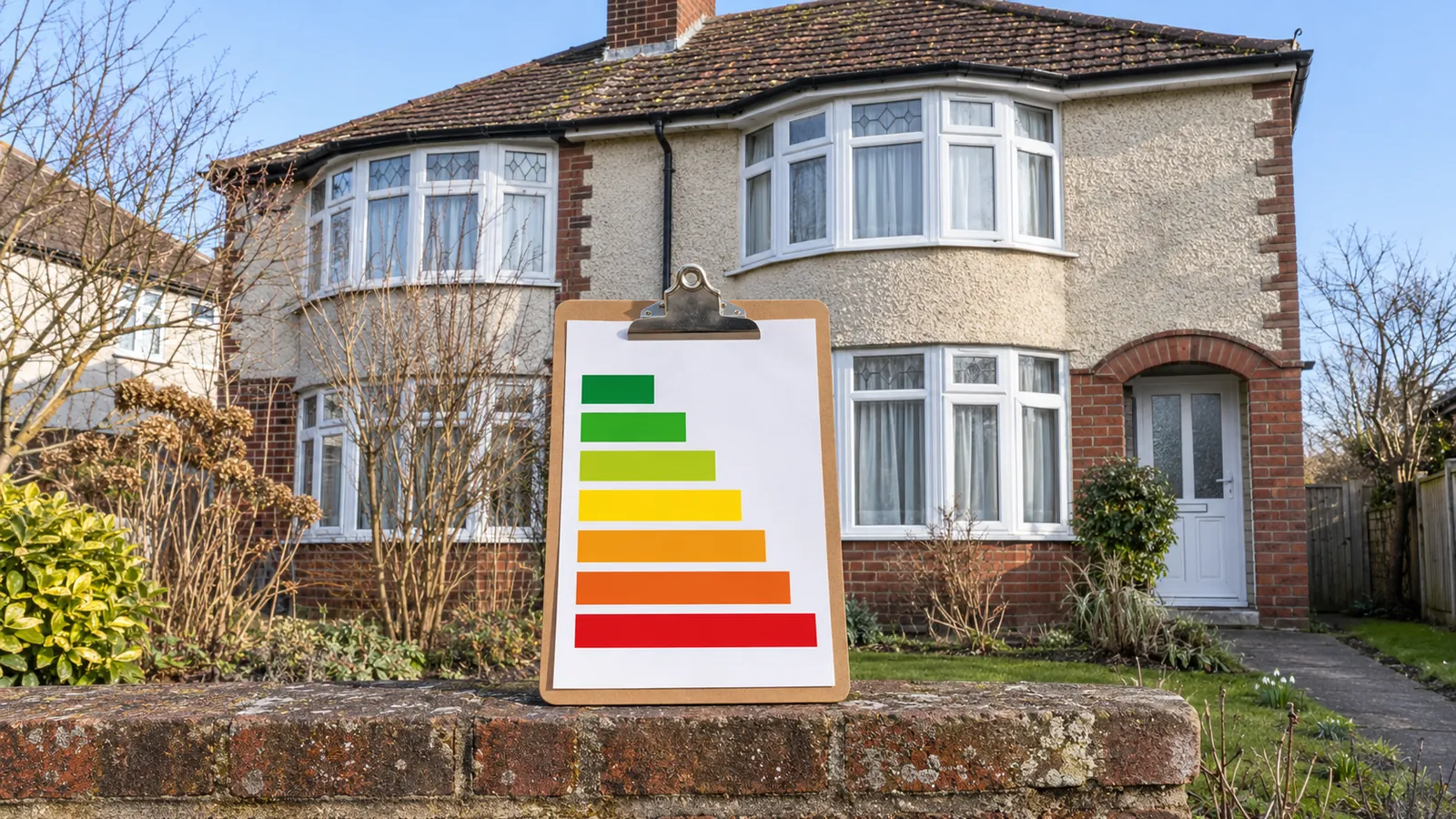

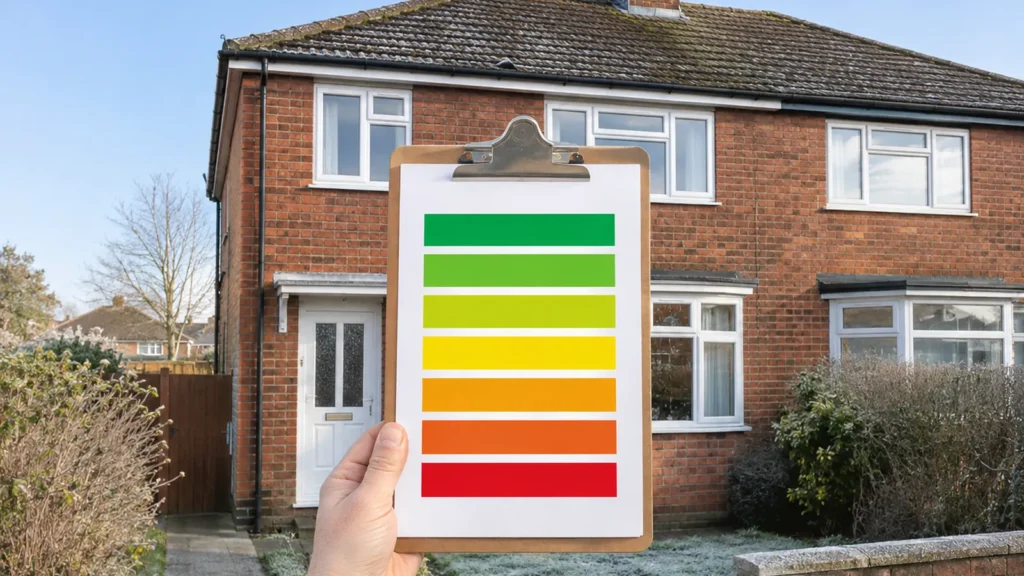
An EPC rates a home from A (most efficient) to G (least efficient), based on a score from 1 to 100 or more. A G is 1 to 20 points and an E is 39 to 54. The typical home in England sits at C by ONS's latest figures, with Wales at D, though older homes are mostly D or below. A lower band generally means higher heating bills, but the certificate's cost figures are estimates under standard assumptions, not a forecast of what you'll pay.
If you've found your certificate and it says G, E or a very ordinary D, you probably want three things: what that means, whether it matters and what to do. Quick context first. The EPC is a standardised estimate of how efficient the building and its heating are, not a record of your bills. We cover the cost and booking side in our EPC certificate cost guide, and the rest of our insulation and EPC section covers the upgrades.
What the EPC bands mean
The band comes from a score, using the government's SAP-based method (the RdSAP version is used for existing homes). A higher score is better.
| Band | Score | Roughly what you'd expect |
|---|---|---|
| A | 92 and over | Very efficient. Rare, mostly new homes with solar and a heat pump |
| B | 81 to 91 | Typical of many newer builds |
| C | 69 to 80 | Good. Often an older home with loft and wall insulation and a modern boiler |
| D | 55 to 68 | Middling. The classic unimproved older house |
| E | 39 to 54 | Below average, with gaps in insulation or old heating |
| F | 21 to 38 | Poor |
| G | 1 to 20 | Very poor. Often solid walls, little insulation and electric or old heating |
Certificates also show a second figure, the potential rating, which is what you'd reach if you did every recommended improvement. And there's a separate environmental impact rating (CO2), which isn't what the headline band shows. Scotland uses its own register and a slightly different set of ratings, so check there if you're north of the border.
One more thing to know: the government has said EPCs will move to new metrics. Until that happens and the rules catch up, the A to G bands above are what lenders, agents and landlord rules use.
What is a typical UK EPC rating?
For "average EPC rating UK", the best public source has been the Office for National Statistics. Its 2025 release, covering EPCs from the ten years to March 2025, gave a median score of 69 (band C) for England and 68 (band D) for Wales. Age matters most: older homes score lower, and the median new build is around 84. Rural areas generally score lower than urban ones.
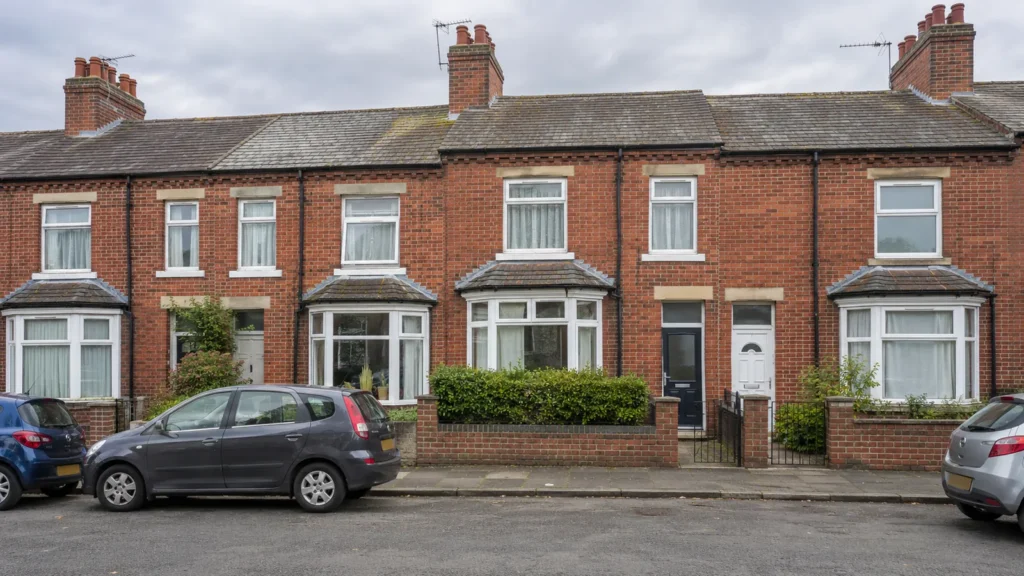
Two cautions. First, a median is the middle home, not a mathematical average, and it only covers homes with an EPC (ONS found most, but not all, dwellings have one). Second, ONS announced in 2026 that it was discontinuing this series, with some figures moving into MHCLG's EPC statistics. Check the latest government release rather than relying on old headlines. Plenty of the older articles still say the typical home is D, which was true a few years back and still holds for many older houses.
Is EPC rating D good?
It's average, and you can live with it. A D is legal to sell and to rent, and no lender will turn you away because of it. The thing to know is that D is where the rules are heading to. If you rent out a property in England or Wales, the government's Warm Homes Plan (January 2026) set out a standard of EPC band C for private rented homes by 1 October 2030, subject to exemptions and a cap on what landlords must spend. For owner-occupiers there's no such rule.
Realistically, a D home is often only a few points and a few modest jobs away from a C. Loft top-up, heating controls and LED bulbs can add up to several points. We cover that below.
What if my EPC rating is G (or F)?
The "epc rating g" search is mostly people asking whether they can still sell or rent.
Selling: Yes. There's no legal minimum to sell. Buyers may negotiate and some mortgage lenders will look hard at a poor rating, but it isn't a bar.
Renting out (England and Wales): Currently, a private tenancy generally needs a rating of E or above, under the Minimum Energy Efficiency Standards. A landlord with an F or G property must either improve it or register a valid exemption, and councils can issue fines for breaches. If you're a tenant in a G-rated home, ask your landlord for the plan, and contact your local council's environmental health team if they won't engage. Scotland and Northern Ireland have their own rules.
Living in it: Nothing forces you to change anything. A G tends to mean a home that's expensive to keep warm and prone to damp, so the practical reasons to improve it are comfort and bills. See how to fix damp if the cold has brought moisture with it.
What does each band cost to run?
People type "epc rating e monthly cost" and want a number. The honest answer: there isn't a single figure, and online tables quoting one are working from different assumptions. Two homes with the same band can have very different bills because the EPC assumes a standard household, standard heating hours and standard weather, not how many people live in the house or how warm you like it.
What you can do is see how the sums work. Ofgem's price cap average for 1 October to 31 December 2026 is 7.97p per kWh for gas and 26.32p per kWh for electricity. Ofgem's "medium" typical household figure is around 11,500 kWh of gas a year. Treat the sum below as an illustration, nothing more.
| Assumption | Sum | Result |
|---|---|---|
| Home using 11,500 kWh gas a year | 11,500 x £0.0797 | About £917 a year, roughly £76 a month, before standing charges |
| The same sort of home but a leakier one using 30% more gas | 14,950 x £0.0797 | About £1,191 a year, roughly £99 a month |
| Difference | About £275 a year, roughly £23 a month |
The 30% figure is made up to show the method. You can't read it off an EPC band. The real saving from moving up a band depends on your fuel (electric heating costs more per kWh than gas), your house size and your habits. If you heat with electricity, the same logic applies at the higher unit price, which is why electric-heated homes often come out poorly on running cost. Our guide to the cheapest electric heaters to run shows the sums.
Your own EPC lists an estimated annual cost for heating, hot water and lighting, plus the saving each recommendation might make. Treat those as a comparison tool. They use past price assumptions and aren't tailored to your household. Property sites give wildly different band-by-band figures for the same reason, so I'd be wary of any that give you a neat monthly price for an E.
Look at your own certificate on the gov.uk "Find an energy certificate" service. The heating cost estimate and the improvement list on that page are specific to your house, and free.
What does it take to move up a band?
Bands are bundles of points, and it's the starting point that decides what you need. As a rough picture for older homes:
- G or F to E: Often loft insulation, a modern boiler or better controls, and draught-proofing. This is the common jump landlords have to make.
- E to D: Cavity wall insulation if your walls are cavity and unfilled, a hot water cylinder jacket, heating controls and low-energy lighting.
- D to C: Usually a combination. A full loft top-up, cavity or solid wall insulation, a newer boiler or a heat pump, double glazing where there's single, or solar panels.
- C to B and above: Typically solar panels, a heat pump and good insulation throughout.
Solid-walled Victorian terraces are the hard cases. A D to C in a house with uninsulated solid walls and a gas boiler can be a big spend, while the same band rise in a 1970s cavity-walled semi may only need a couple of cheaper jobs. How many points each job is worth varies house to house, so work from the improvements list on your own certificate.
Quick wins to raise your rating
Roughly in order of cost, and starting with the ones that cost the least.
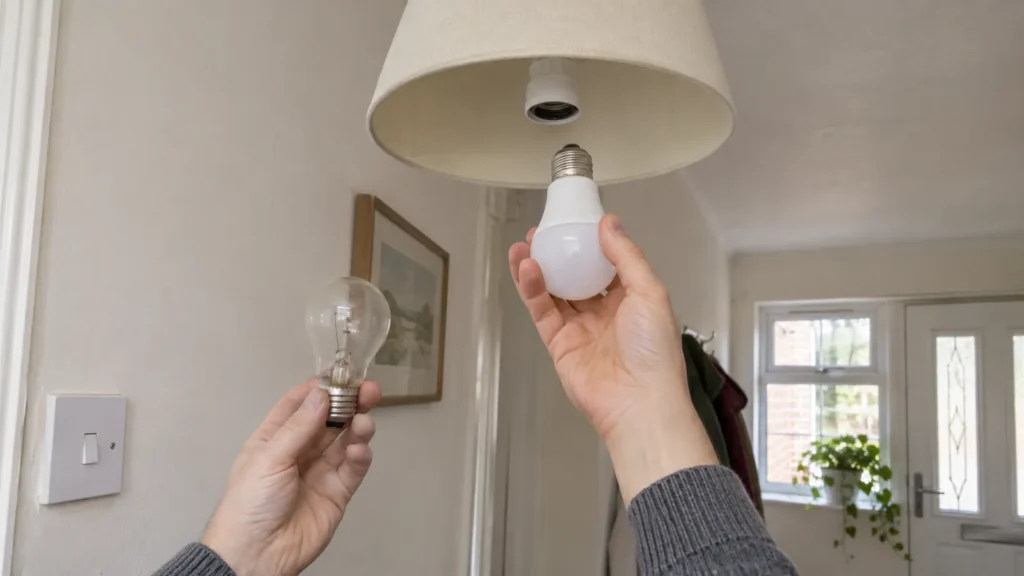
- Swap every bulb for LED. Lighting is part of the score. It costs very little.
- Cylinder jacket and pipe lagging. If you have a hot water tank, an insulating jacket is cheap and lifts points on poorly insulated tanks.
- Heating controls. A programmer, room thermostat and thermostatic radiator valves are worth points on an older system.
- Loft insulation up to about 270mm. One of the best value jobs. See our loft insulation guide.
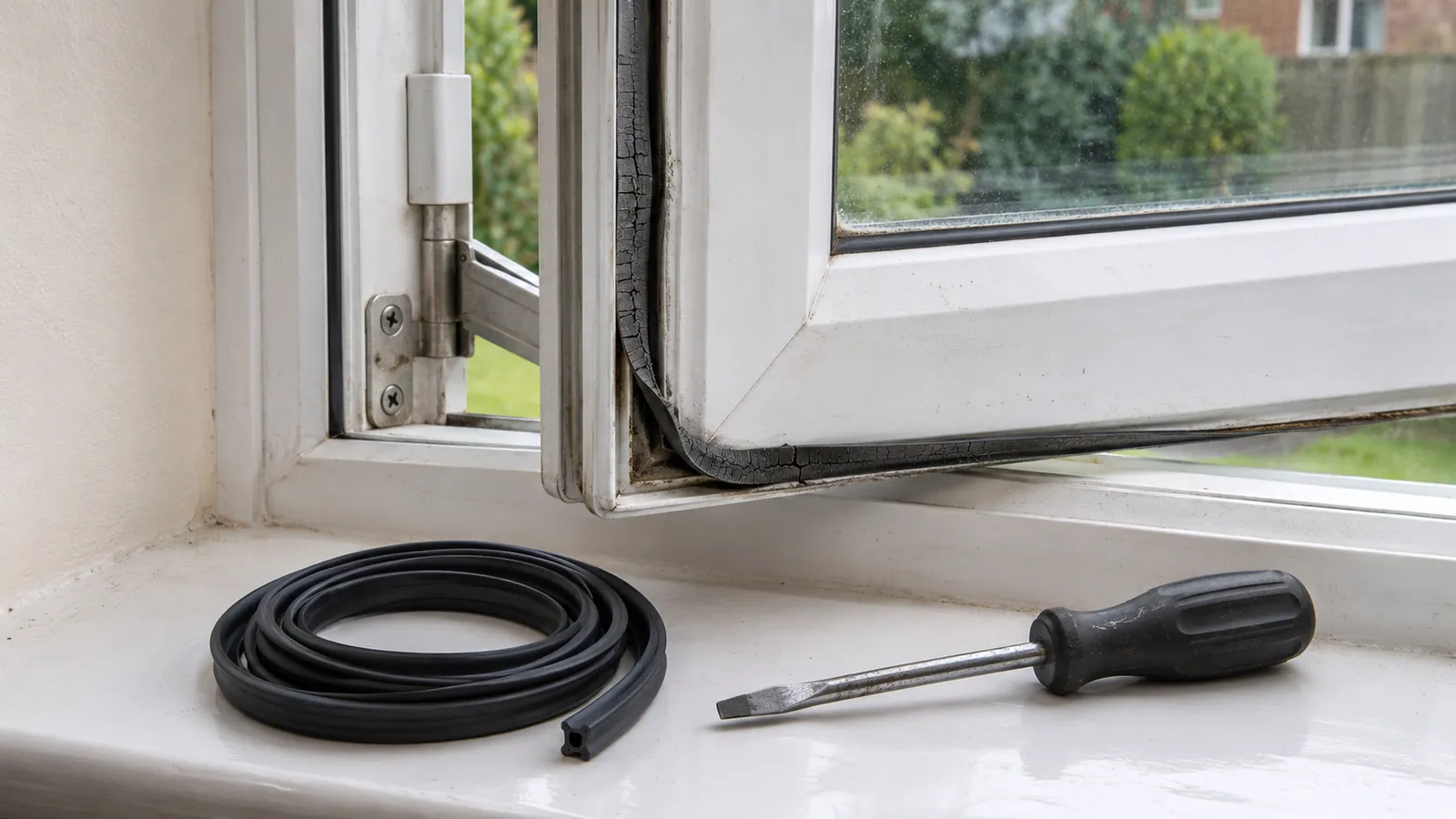
- Draught-proofing. Good for comfort, though it moves the EPC less than you'd hope. See draught-proofing.
- Cavity wall insulation where it is suitable and not already done.
- Heating system. A new condensing boiler or, in the right home, an air source heat pump.
- Solar panels. These can add a good number of points.
And then there's proving what you already have. If your cavity walls were filled years ago or your windows replaced, the assessor can't always see it. Without paperwork (a CIGA guarantee, FENSA certificate, receipts), they may have to assume the worst. Gather it before the assessment. If you only have a few tired windows, our guide to how long double glazing lasts explains whether glazing work is worth doing.
Insulate and seal a home without thinking about ventilation and you can trade a bad EPC for a mould problem. Keep trickle vents open and extractor fans working after any upgrade.
Grants change frequently. The Boiler Upgrade Scheme helps with heat pumps, ECO4 is due to end on 31 December 2026, and the Warm Homes Plan promises new support. Check gov.uk for what is open before you pay for work.
Buying, selling and mortgages
For a buyer, the EPC is a prompt to ask what the home will cost to heat and what upgrades the property will need. It's also a negotiating tool: a G or F with an expensive wall-insulation list is a fair reason to ask for a lower price.
Some lenders offer "green" or "energy efficient" mortgages, typically a lower rate or cashback for homes in a high band (often A to C) or for a loan used for improvements. These products vary, change often and the saving is usually small, so compare the total cost against a normal deal rather than choosing on the label. Some lenders also offer extra borrowing for energy upgrades. Ask a broker. A poor EPC on its own generally doesn't stop you getting a mortgage, though a lender may want to understand any rental plans if the property is going to be let.
If you're selling, an EPC lasts 10 years, so you don't need a new one unless yours has expired. It's worth a new one if you've done real work since the last.
FAQs
What does EPC rating G mean?
It means the property scores between 1 and 20 points, the lowest band. Typically that means poor insulation and heating. You can still sell a G-rated home, but you can't normally let one in England or Wales without an exemption.
Is EPC rating D good?
It's about average for an older home. It's legal to sell and let, and with a few improvements many D homes can reach a C. The planned rental standard of C by October 2030 in England and Wales is the reason landlords are paying attention.
What is the average EPC rating in the UK?
ONS's 2025 release put the median in England at 69 (band C) and in Wales at 68 (band D). Older homes score lower, and new builds score higher, around 84. Scotland and Northern Ireland have their own data.
How much does an EPC E rating cost to run per month?
There isn't an official monthly figure for a band. Costs depend on your fuel, house size and habits. Use the estimated cost on your own certificate for comparison, and work out your likely bill from your actual kWh use and unit prices.
Can I rent out a house with an EPC rating of E?
Yes, currently. E is the minimum for most private lets in England and Wales. The government plans to raise this to C by 1 October 2030, subject to exemptions and a spending cap.
Will a better EPC increase my house value?
Possibly, but results vary by area and property, and I wouldn't promise a figure. A higher band makes a home easier to market and cheaper to run, which buyers do notice.
Do I have to improve my EPC if I live in the house?
No. There are no rules requiring owner-occupiers to improve their rating. The rules apply to rented homes.
- Bands run from A (92+) to G (1 to 20). D is 55 to 68 and E is 39 to 54.
- ONS's latest figures put the median home in England at C and Wales at D, but older homes are mostly lower.
- No reliable monthly cost exists per band. Use the estimates on your own certificate, or work from your kWh use and unit prices.
- Landlords in England and Wales need E now and C is planned for 1 October 2030.
- LEDs, controls, loft insulation and paperwork for hidden insulation are the cheap places to start.