
Electric underfloor heating uses thin heating mats, loose cables or carbon film under your floor. It's cheap and quick to fit compared with a wet (water) system, which makes it popular for bathrooms, kitchens and conservatories. Running it costs power (kW) × hours × your unit rate. At 26.32p per kWh, a 4m² bathroom mat at 150W/m² costs about 16p an hour at full power, and less once the thermostat cycles. It's great as comfort heating in small rooms, but expensive as the only heat source for a whole house.
Warm tiles under bare feet on a cold morning is one of the nicest upgrades you can make to a UK bathroom. Electric underfloor heating is also one of the most misunderstood. People are either told it costs a fortune to run or that it's practically free. The truth sits in the middle and depends on the room, the floor and how you use it. For the bigger picture on keeping your home warm, see our heating guide.
How does electric underfloor heating work?
A thin electric heating element sits just under your floor finish. When it's switched on, it warms the floor, and the floor warms the room. Because the whole floor gives off gentle heat, the room feels evenly warm, with no cold corners and no hot spot by a radiator.
Every system has three parts:
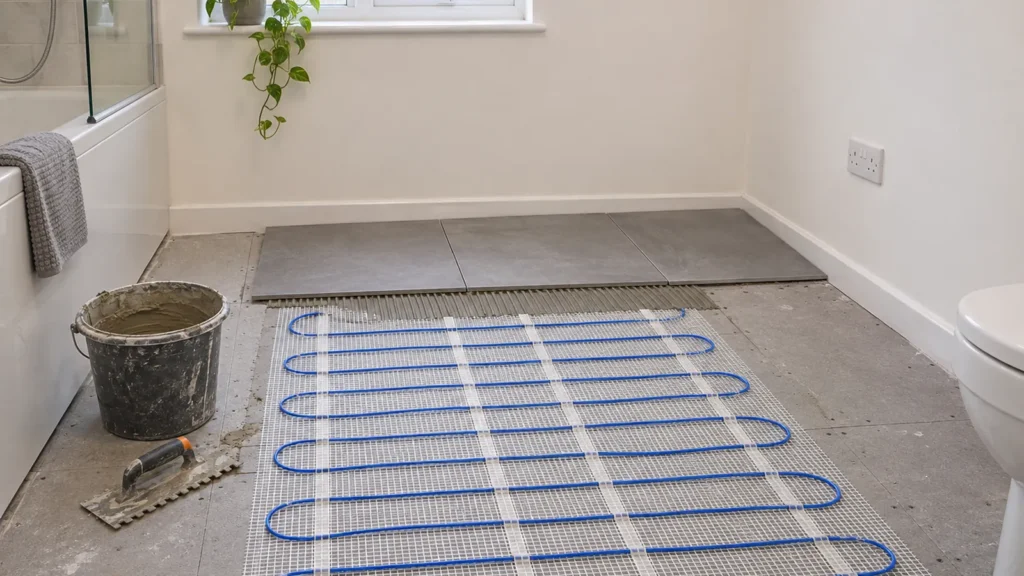
- The heating element: a mat, loose cable or film laid across the floor.
- Insulation boards underneath, so the heat goes up into the room and not down into the subfloor.
- A thermostat with a floor probe, which switches the heating on and off to hold the temperature you set.
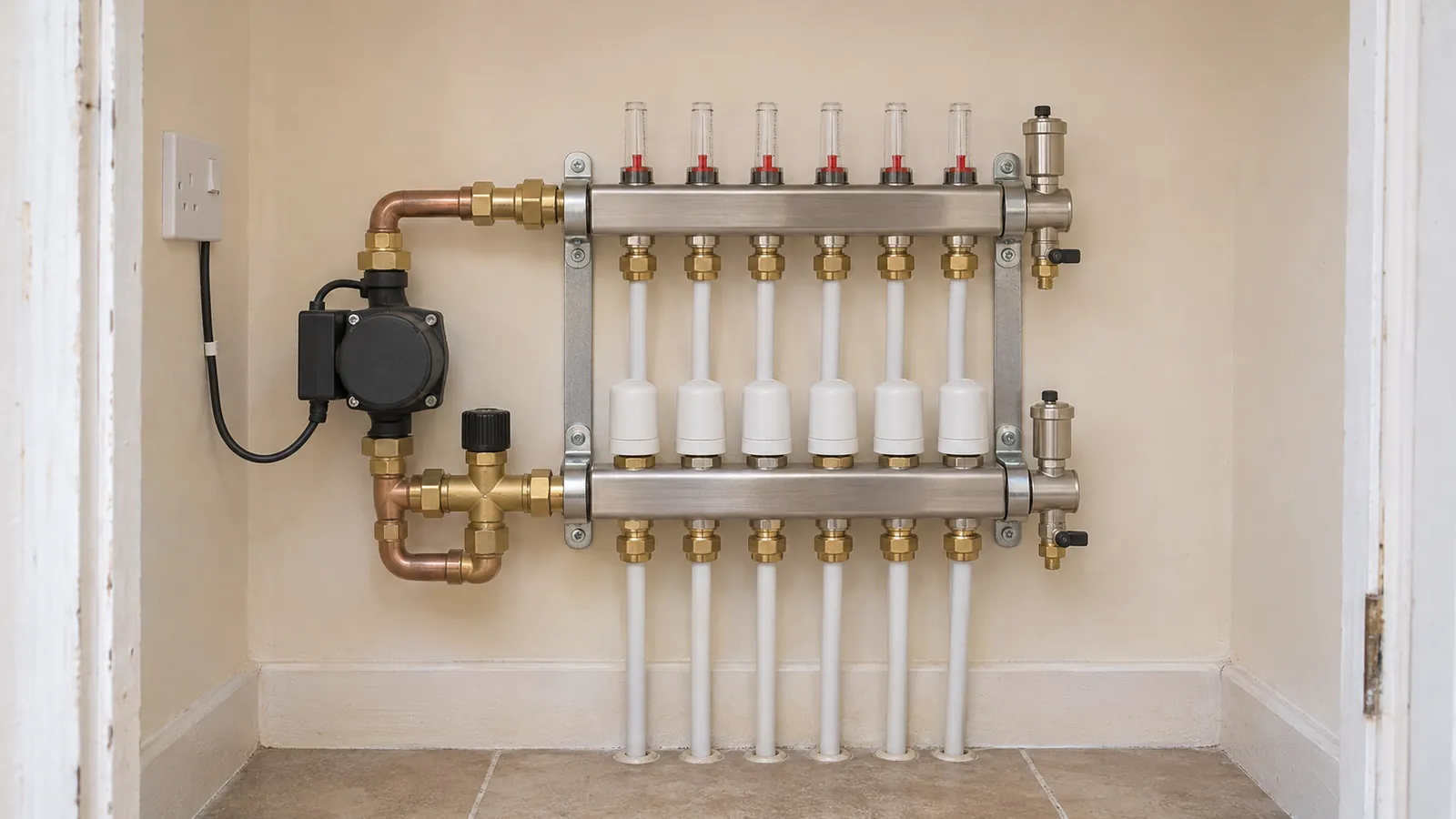
It's different from wet underfloor heating, which pumps warm water from your boiler or heat pump through pipes buried in screed or laid in special panels. More on that comparison below.
Types of electric underfloor heating
Heating mats
A mat is a heating cable already fixed at even spacing onto a fibreglass mesh. You roll it out, cut the mesh (never the cable) to turn at the walls, and tile straight over it in a layer of flexible tile adhesive.
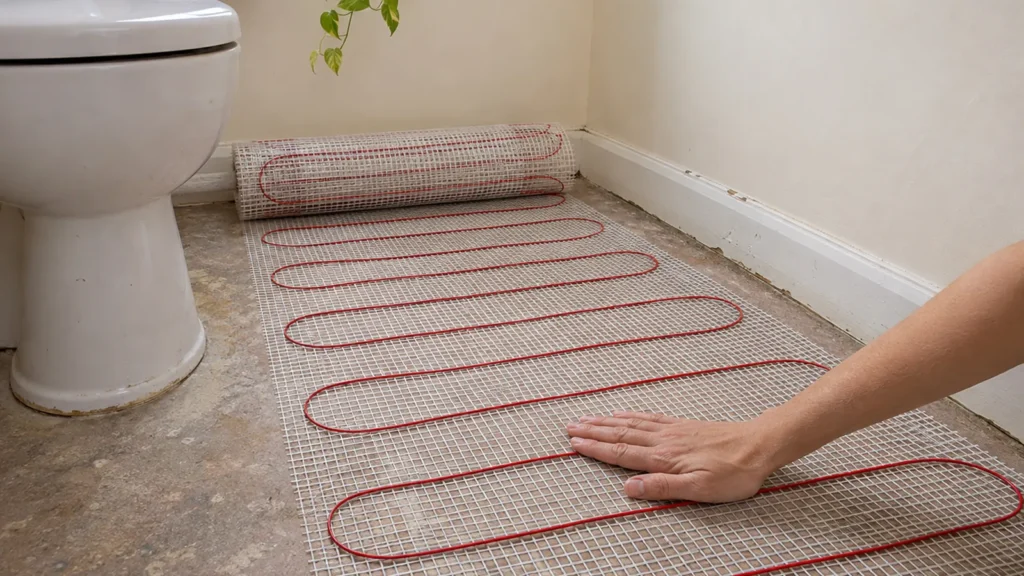
- Best for: tiled and stone floors in regular-shaped rooms, so most bathrooms and kitchens.
- Pros: quick to lay, even spacing, the easiest DIY-friendly type to lay out.
- Cons: less flexible around awkward shapes like toilets, pedestals and curved walls.
Loose cable systems
Here you get a single long heating cable and clip it to fixing strips, setting the spacing yourself.
- Best for: awkward, L-shaped or small rooms where a mat won't fit neatly.
- Pros: you can get coverage into odd corners, and change the output by changing the spacing.
- Cons: slower and fiddlier to lay, and easy to get the spacing wrong.
Foil and carbon film (for laminate and wood)
Foil mats and carbon film are very thin sheets that sit on an underlay under floating floors such as laminate and engineered wood. They spread low, gentle heat across the whole sheet.
- Best for: electric underfloor heating for laminate, engineered wood and some click vinyl floors.
- Pros: no adhesive or screed, very thin, quick to lay over an insulated underlay.
- Cons: lower output, so they're comfort heating rather than strong primary heat. Check the flooring maker allows underfloor heating and its maximum floor temperature (often around 27°C for wood and laminate).
| Type | Typical floor finish | Typical output | Ease of laying |
|---|---|---|---|
| Heating mat | Tile, stone | About 100–200W/m² | Easy in regular rooms |
| Loose cable | Tile, stone, some vinyl | Depends on spacing | Fiddly, good for odd shapes |
| Foil / carbon film | Laminate, engineered wood | About 100–140W/m² | Easy, but floating floors only |
Outputs vary by product. Always go by the manufacturer's figures and floor-finish rules.
How much does it cost to run electric underfloor heating?
This is the bit most people get wrong, so here's the honest maths.
Cost per hour = (output in W/m² × heated area in m² ÷ 1,000) × unit rate
At the Ofgem price cap average of 26.32p per kWh (1 October to 31 December 2026), at full power:
| Room | Heated area | Mat output | Load | Cost per hour (full power) |
|---|---|---|---|---|
| Small bathroom | 3m² | 150W/m² | 0.45kW | 12p |
| Bathroom | 4m² | 150W/m² | 0.6kW | 16p |
| Large bathroom | 6m² | 200W/m² | 1.2kW | 32p |
| Kitchen (comfort heat) | 10m² | 150W/m² | 1.5kW | 39p |
| Living room (main heat) | 15m² | 200W/m² | 3kW | 79p |
Only count the area that's actually heated. You don't lay mats under the bath, the kitchen units or a fitted wardrobe, so the heated area is usually smaller than the room.
The thermostat cuts the real cost
The table above assumes the heating never switches off. In real life the thermostat cycles it on and off once the floor reaches temperature. How much of the time it's on depends on:
- how well the floor is insulated underneath (the biggest factor)
- the floor finish (tiles heat up and hold heat well; thick carpet resists it)
- how cold the room and the outside are
- the temperature you set
Example only, to show the maths: a 4m² bathroom mat (0.6kW) runs for 2 hours each morning and is on for about half that time once warm.
- Energy: 0.6kW × 2 hours × 0.5 = 0.6kWh a day
- Cost: 0.6 × 26.32p = about 16p a day, or roughly £4.80 a month
With no insulation board on a cold concrete floor, the element might run nearly all the time and the cost would roughly double.
Try your own numbers. Type in the total wattage of your system (output × heated area), the hours you use it and your unit rate:
Appliance running cost calculator
– · Default price: Ofgem price cap average, 1 Oct–31 Dec 2026. Check your bill for your exact unit rate.
Prefer a full page? Use the running cost calculator.
Use a programmable thermostat. Set it to warm the bathroom floor for an hour before you get up and switch off once everyone's showered. Timing is the single biggest money-saver with any electric heating.
Is electric underfloor heating expensive to run?
In a small room used for short periods, no. A bathroom or en-suite costing pennies a day is normal.
As the main heat for a whole house, it usually is. Electricity costs about three times as much per kWh as gas (about 26.32p against 7.97p under the current cap). Heating every room electrically for many hours a day adds up fast, just like any other direct electric heating. If you're comparing options for a whole flat on electric-only heating, see our guides to the cheapest electric heater to run and Economy 7 storage heaters.
How much does electric underfloor heating cost to install?
Prices vary a lot by region, room and floor. These are typical UK ranges for 2026, as estimates only. Get quotes for your job.
| Item | Typical cost (estimate) |
|---|---|
| Electric underfloor heating kit (mat + thermostat), per m² | About £30–£80 per m² |
| Insulation boards, per m² | About £10–£25 per m² |
| Smart or Wi-Fi thermostat (if not in the kit) | About £60–£200 |
| Electrician to connect, test and certify | About £150–£400 for a simple bathroom connection |
| Fully installed small bathroom (about 4m²), excluding tiling | Often around £600–£1,500 |
Things that push the price up:
- A new circuit from the consumer unit, especially if the board needs upgrading
- Levelling or preparing an uneven floor
- Lifting an existing floor (most people fit it during a bathroom or kitchen refit)
- Tiling, which is a separate cost
The cheapest time to fit electric underfloor heating is during a refit, when the old floor is already up. The mat itself is a small part of the bill compared with the flooring and tiling.
Can you fit electric underfloor heating yourself?
You can usually lay the mat and insulation boards yourself, but the electrical connection is a job for a registered electrician.
Part P: what the rules say
In England and Wales, electrical work in homes is covered by Part P of the Building Regulations. Some work is notifiable, which means it must be either done by an electrician registered with a competent person scheme (such as NICEIC or NAPIT), who can self-certify it, or reported to local building control before you start.
Notifiable work includes:
- Any new circuit, wherever it is in the house
- Replacing a consumer unit
- Adding to or altering a circuit in a special location, such as a room with a bath or shower
So underfloor heating in a bathroom or shower room is almost always notifiable, and a new dedicated circuit for a big system anywhere is notifiable too. Underfloor heating also needs RCD protection. Scotland and Northern Ireland have their own rules.
Never cut or shorten the heating cable itself, never overlap or cross cables, and never lay a mat under fixed units, baths or the toilet base. A damaged cable can be dangerous and usually means lifting the floor to fix it. Test the mat's resistance before, during and after laying, as the manual says.
A sensible DIY split
- You: clear and prepare the floor, fit insulation boards, lay the mat or film to the plan, and test it with a multimeter as you go.
- Electrician: connect the cold tail to the thermostat and supply, fit RCD protection, test and give you an electrical installation certificate.
- You or your tiler: tile or lay the floor finish, following the mat maker's adhesive and drying guidance.
Keep the certificate and the mat's test record. You'll need them for the warranty and when you sell the house.
Insulation boards: why they matter so much
Without insulation, a lot of the heat goes down into the subfloor instead of up into the room. That means slower warm-up and higher bills.
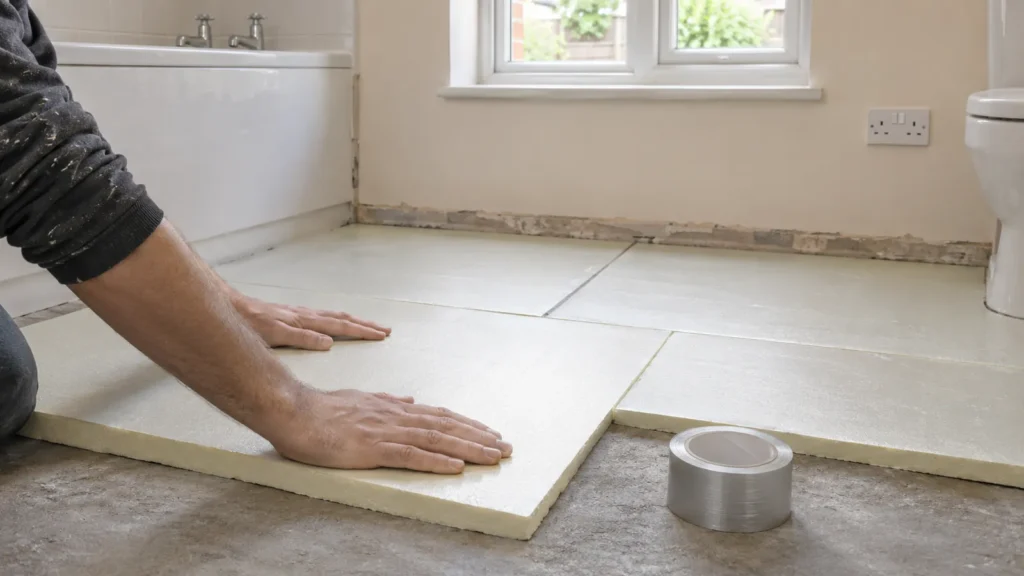
- On a concrete floor, insulation boards make the biggest difference, because cold concrete soaks up heat.
- On timber floors, insulation still helps and gives a flat, stable base for tiles.
- Typical boards are about 6mm to 20mm thick. Thicker boards insulate better but raise the floor more, so check door heights and thresholds.
If your house loses heat through the roof and draughts as well, fixing those first makes any heating cheaper to run. See our guides to loft insulation and draught-proofing.
Electric underfloor heating under laminate and tiles
Underfloor heating under tiles
Tiles and natural stone are the best floor finishes for underfloor heating. They conduct heat well and warm up nicely. A mat set in flexible tile adhesive is the usual setup. Use a flexible adhesive and grout rated for underfloor heating, and follow the drying times before switching the heating on. Bring the temperature up slowly the first time.
Electric underfloor heating for laminate
For laminate and engineered wood, use a foil mat or film system designed for floating floors, laid over the recommended underlay.
- Check the flooring is approved for underfloor heating.
- Keep within the flooring's maximum surface temperature (often around 27°C).
- Use a thermostat with a floor probe, so the floor can't overheat.
Carpet and rugs
Carpet can work, but the combined tog value of carpet and underlay needs to be low (many makers suggest a total of no more than about 2.5 tog). A thick carpet and underlay act like a duvet and slow the heat down. Big rugs on a heated floor have the same effect.
Electric vs wet underfloor heating
| Electric underfloor heating | Wet underfloor heating | |
|---|---|---|
| Heat source | Electricity | Boiler or heat pump |
| Install cost | Low for a single room | Higher, needs pipework, manifold, often screed |
| Running cost | Higher per kWh (electricity) | Lower, especially with a heat pump |
| Floor height | Adds very little | Can add more, depending on system |
| Best for | Single rooms, refits, bathrooms | Whole floors, new builds, extensions |
| Disruption | Low | Higher |
Rule of thumb: electric for one or two small rooms, wet for large areas or whole floors, especially if you have or are getting a heat pump. Wet underfloor heating runs at low water temperatures, which suits condensing boilers and heat pumps well. Our guide to boiler temperature explains why lower flow temperatures help efficiency.
Which rooms suit electric underfloor heating best?
- Bathrooms and en-suites. Small area, short use, and warm tiles help dry the floor after showers. A warm, dry room is also less likely to get mould. See our guide to mould on bathroom ceilings.
- Kitchens. Comfort heating under tiles, especially in a refit where wall space for radiators is tight.
- Conservatories and garden rooms. Can help, but these rooms lose heat fast. Insulate well, or the running cost climbs.
- Small extensions. Fine as comfort heat if well insulated, but for larger extensions, wet underfloor heating is usually better value long term.
Rooms where it's a weaker choice: large, poorly insulated rooms you heat for long hours, and rooms with thick carpet.
How to use electric underfloor heating efficiently
- Set a schedule. Warm the floor before you use the room, not all day.
- Don't crank it up. About 24–27°C feels warm underfoot. Higher costs more and can damage some floors.
- Start it 30–60 minutes early. It warms up more slowly than a fan heater.
- Keep the floor clear. Big rugs and pet beds trap heat.
Weighing it up against a wet system or plain radiators? See underfloor heating vs radiators for the running cost sums.
FAQs
How much does electric underfloor heating cost to run per m²?
Multiply the output by the unit rate. A 150W/m² mat uses 0.15kW per m², which costs about 4p per m² per hour at full power at 26.32p per kWh. A 200W/m² mat is about 5p per m² per hour. Real costs are lower once the thermostat cycles.
Is electric underfloor heating worth it?
For a bathroom, en-suite or kitchen during a refit, usually yes: it's cheap to fit, comfortable and costs pennies a day to run in a small room. As whole-house heating on a standard electricity tariff, it's usually expensive to run.
Can I leave electric underfloor heating on all the time?
You can, but it will cost more than using a schedule. Most people save money by heating the floor only when the room is in use.
Does electric underfloor heating need its own circuit?
Small bathroom mats can often run from a fused spur on an existing circuit, but larger systems need a dedicated circuit. Either way, in a bathroom it's notifiable under Part P, so have a registered electrician decide and do the connection.
Can you put electric underfloor heating under laminate?
Yes, with a foil or film system made for floating floors, an approved underlay and laminate that's rated for underfloor heating. Keep within the floor's maximum temperature.
How long does electric underfloor heating take to warm up?
Typically 30 minutes to an hour over insulation boards. On bare concrete with no insulation it can take much longer, which is why insulation boards are worth it.
- Electric underfloor heating costs output × heated area × hours × unit rate. A 4m² bathroom mat is about 16p an hour at full power.
- The thermostat and insulation boards cut the real cost a lot. Use a schedule.
- Mats for tiles, loose cable for awkward rooms, foil or film for laminate.
- Laying the mat can be DIY, but the connection is notifiable Part P work in bathrooms. Use a registered electrician.
- It's best for small rooms and refits. For whole floors or houses, wet underfloor heating is usually cheaper to run.