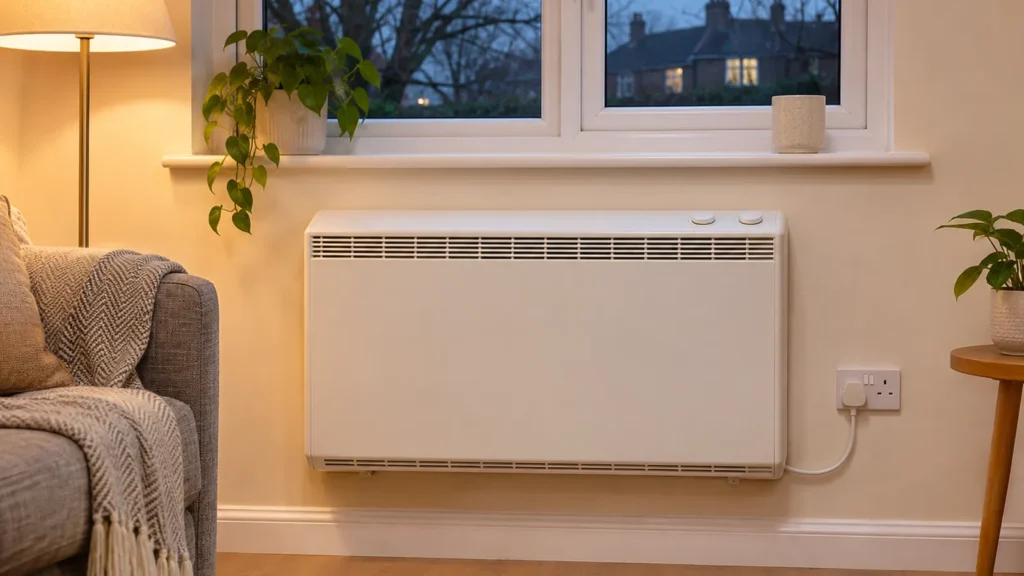
Economy 7 storage heaters charge up overnight on cheaper electricity and release the heat during the day. Use the input (charge) dial to set how much heat they store overnight, and the output (boost) dial to control how fast they release it, keeping output low in the morning and turning it up in the evening. Economy 7 gives you 7 hours of cheaper electricity, usually between about midnight and 7am, but the exact times depend on your meter and supplier, so check your bill or ask your supplier.
Storage heaters are common in UK flats and homes without mains gas. Used well, they're one of the cheapest forms of electric heating. Used badly, they leave you cold by evening and paying peak rates for top-up heat. This guide covers how they work, the settings, Economy 7 times and costs, modern alternatives and grants. For other electric heating options, see the cheapest electric heater to run.
How do Economy 7 storage heaters work?
Inside a storage heater are heat-retaining bricks (usually ceramic) surrounded by insulation. Overnight, during your cheap Economy 7 hours, electric elements heat the bricks. During the day, the heater gives that heat off into the room, partly through its casing and partly through a vent or flap controlled by the output dial.
Storage heater settings: input and output explained
| Dial | What it does | How to set it |
|---|---|---|
| Input (charge) | How much heat the heater stores overnight | Higher in cold weather, lower in mild weather. Adjust the day before. |
| Output (boost / room temperature) | How fast the stored heat is released | Low or off when you go to bed and leave in the morning; turn up in the late afternoon and evening |
A good routine for typical winter weather:
- Input: about 3–4 (out of 6) in mild weather, 5–6 in very cold spells.
- Output: set to minimum before bed and when you leave the house.
- Late afternoon: turn the output up to release the stored heat when you're home.
- Adjust the next day: if heat runs out by evening, raise the input; if rooms are too warm in the morning, lower it.
Storage heaters lose some heat all day through their casing, even on the lowest output. Older models leak a lot, which is why rooms are often warmest when you don't need it. Modern "high heat retention" models (see below) fix much of this.
What time does Economy 7 start and finish?
Economy 7 gives 7 hours of cheaper electricity overnight. The most common window is roughly midnight to 7am, or 00:30 to 07:30, but:
- Times vary by region, meter and supplier. Some meters switch at different times, and some split the 7 hours.
- Most older meters work on GMT all year, so in summer (BST) the cheap period runs an hour later on the clock.
- Smart meters on Economy 7 tariffs use the times set by your supplier.
Check your bill or your supplier's website, or ask your supplier directly. Many show the times in your online account.
How much does Economy 7 cost to run?
Economy 7 has two unit rates: a cheaper night rate (often around half the day rate) and a more expensive day rate (usually higher than a standard single-rate tariff). It saves money only if you use a big share of your electricity at night, typically at least 40% or so.
| Heater size | Typical charge per night (full input) | Approx. nightly cost at a 14p night rate |
|---|---|---|
| Small (1.7kW) | ~12 kWh | ~£1.70 |
| Medium (2.55kW) | ~18 kWh | ~£2.50 |
| Large (3.4kW) | ~24 kWh | ~£3.35 |
These are maximums: most nights you won't charge at full input. Check your bill for your actual night and day rates; the calculator below works out any appliance at any rate:
Appliance running cost calculator
– · Default price: Ofgem price cap average, 1 Oct–31 Dec 2026. Check your bill for your exact unit rate.
Using panel heaters, fan heaters or the storage heater's boost during the day on Economy 7 is expensive, because day-rate electricity costs more than on a standard tariff. Plan heating around the night charge where you can.
Economy 7 and hot water
Many Economy 7 homes heat water with a hot water cylinder that has two immersion elements (dual immersion):
- The bottom element heats the whole tank overnight on cheap electricity.
- The top element boosts a smaller amount of water during the day, at the expensive rate.
Use the overnight heat-up wherever possible, and only boost when you really need extra hot water. A well-insulated cylinder (a factory foam coating or a thick jacket) keeps the water hot until evening.
Modern storage heaters vs old ones
Modern high heat retention storage heaters (for example Dimplex Quantum and similar models from other brands) have much better insulation, digital controls, room thermostats and timers. They keep more heat in until you need it and release it automatically to hit a set temperature.
| Old storage heater | High heat retention heater | |
|---|---|---|
| Heat loss during the day | High | Low |
| Controls | Two manual dials | Digital thermostat and timer |
| Comfort in the evening | Often cold | Much better |
| Typical cost (each, fitted) | — | £600–£1,200 |
Storage heater grants
Grant-funded storage heater upgrades were mostly delivered through the ECO4 scheme, which closed to new installations at the end of March 2026. Newer support is being set out under the government's Warm Homes Plan, and some local councils run their own schemes, especially for homes without mains gas or with a low EPC rating. Check gov.uk and your council for what is open now before contacting installers. See our insulation and EPC guide for more on grants.
Is Economy 7 being phased out?
Economy 7 tariffs aren't being scrapped, but some older Economy 7 and Economy 10 meters were controlled by the Radio Teleswitch Service (RTS), a radio signal. According to Energy UK, the RTS phase-out was completed on 30 June 2026. If you still have an RTS meter, your heating and hot water may switch on and off at the wrong times, so contact your supplier promptly to arrange a replacement, usually a smart meter that can keep a similar time-of-use tariff.
FAQs
What should I set my storage heaters to?
Input around 3–4 in mild weather and 5–6 when it's very cold; output low overnight and in the morning, turned up in the late afternoon and evening.
What time does Economy 7 start?
Usually around midnight, giving 7 cheap hours until about 7am, but it varies by meter, region and supplier. Check your bill or ask your supplier.
Are storage heaters expensive to run?
They're among the cheaper forms of electric heating because they charge on cheap night-rate electricity, but old models waste heat during the day. Modern high heat retention models are more efficient.
Should I leave storage heaters on all the time?
Leave them on charge overnight in cold weather, but control the output: keep it low when you don't need heat and turn it up when you do.
Is Economy 7 worth it?
It's usually worth it if you have storage heaters or an electric hot water cylinder, or charge an electric car overnight. If most of your use is in the daytime, a standard tariff may be cheaper.
Can I get free storage heaters?
ECO4 has closed to new installations, but you may qualify for newer support under the Warm Homes Plan or a local council scheme. Check gov.uk and your council for current eligibility.
- Input = how much heat is stored overnight; output = how fast it's released.
- Keep output low in the morning, turn it up in the evening.
- Economy 7 gives 7 cheap hours overnight, but times vary: check your bill.
- Modern high heat retention heaters, often grant-funded, are far better than old ones.