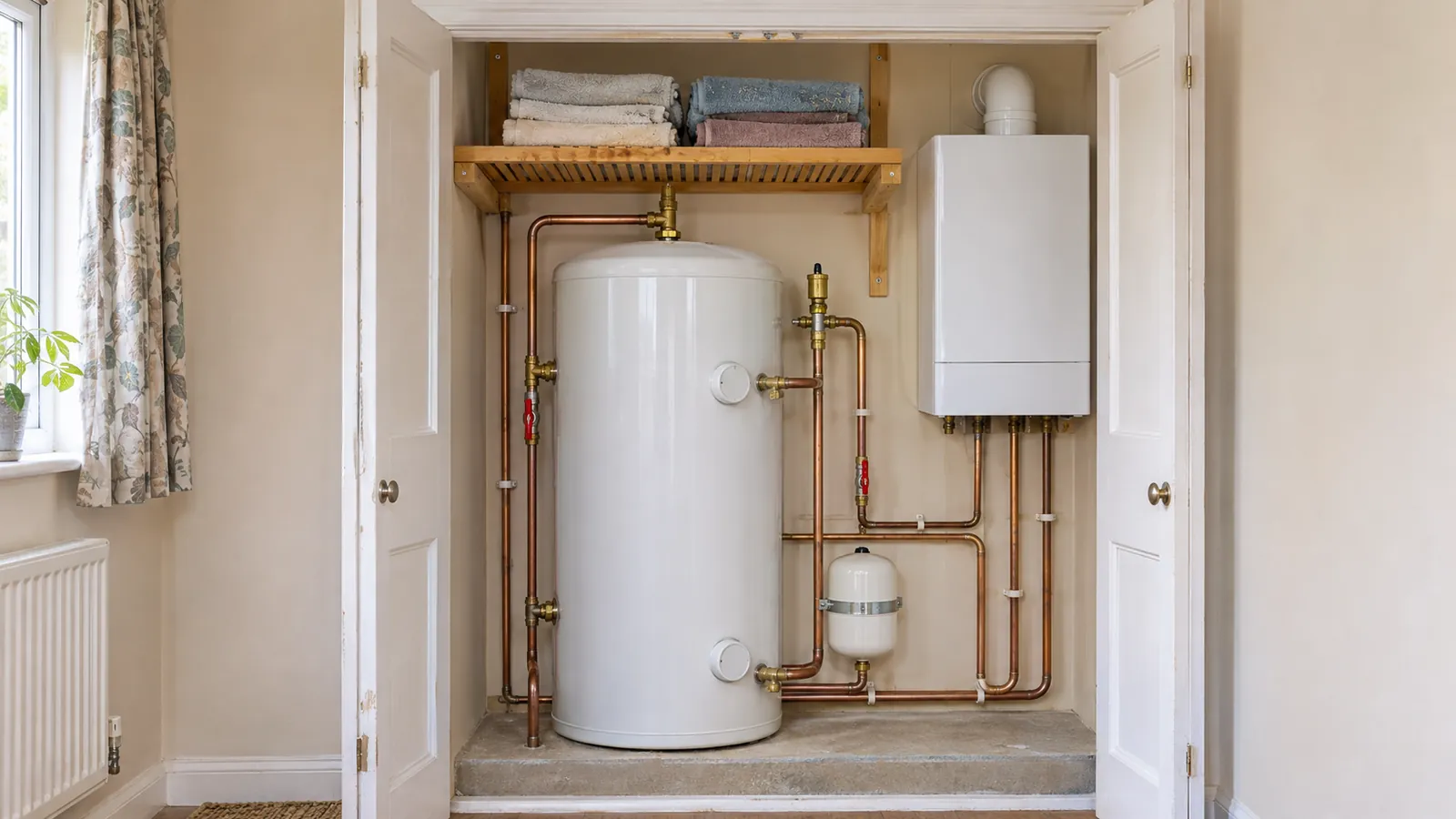


Look for a hot water cylinder and a cold water tank. No cylinder and no tank in the loft, and hot water comes straight from the boiler: you have a combi boiler. A hot water cylinder in an airing cupboard but no tanks in the loft: a system boiler. A cylinder and a cold water tank (plus a small feed-and-expansion tank) in the loft: a regular boiler, also called a conventional or heat-only boiler. Your exact make and model are on the data badge, usually under the front cover flap or on the underside.
Knowing your boiler type helps with almost everything: following the right troubleshooting steps, booking an engineer, comparing replacement quotes and understanding your bills. You don't need to take anything apart to find out. For more on keeping your heating working, see our home heating guide.
The three main types of boiler at a glance
Almost every gas or oil boiler in a UK home is one of three types. The quick version:
| Combi boiler | System boiler | Regular (heat-only) boiler | |
|---|---|---|---|
| Hot water cylinder | No | Yes | Yes |
| Cold water tank in the loft | No | No | Yes |
| Small feed-and-expansion tank in the loft | No | No | Yes |
| Pressure gauge on the boiler | Yes | Yes | Usually no |
| Hot water | On demand, heated as you use it | Stored in the cylinder | Stored in the cylinder |
| Typical home | Flats and small to medium houses | Medium to large homes, more than one bathroom | Older homes, often with older pipework |
The quickest single test: turn on a hot tap when the heating is off. If you hear the boiler fire up straight away and the water gets hot within a few seconds, without any cylinder in the house, it's almost certainly a combi.
Step 1: Look for a hot water cylinder
A hot water cylinder is a large round tank, usually copper (bare or covered in yellow or green foam) or a white or grey modern unvented cylinder. It's most often in:
- an airing cupboard on the landing or in a bedroom
- a cupboard next to the bathroom
- a utility room, loft or garage (less common)
No cylinder anywhere? You almost certainly have a combi boiler. A combi heats water for your taps directly from the mains, so there's nothing to store.
Found a cylinder? You have either a system boiler or a regular boiler. Move on to Step 2.
An immersion heater switch (often a red or white switch on the wall marked "immersion" or "water heater") near the cylinder is a clue that you have stored hot water. It doesn't tell you the boiler type on its own, because both system and regular boilers can have one.
Step 2: Check the loft for water tanks
Only go into the loft if it's safe to do so: use a proper loft ladder, stand on boards or joists, and take a torch.

- One large cold water storage tank (often plastic, sometimes old galvanised steel or asbestos cement in very old homes) plus a small tank next to it: this is a regular boiler set-up. The big tank feeds the cylinder; the small one is the feed-and-expansion tank for the heating.
- No tanks at all, or only a disconnected old tank: you most likely have a system boiler (with a cylinder) or a combi (without one).
Some homes with an unvented cylinder (a sealed, mains-pressure cylinder) have no loft tanks even though they have stored hot water. That's normally paired with a system boiler.
If you find an old tank that looks like grey cement board, don't drill, cut or break it. Some older tanks contain asbestos. Leave it alone and ask a professional to check it.
Step 3: Look at the boiler itself
The boiler gives you plenty of clues without removing any covers.

Is there a pressure gauge?
Combi and system boilers run as sealed systems and almost always have a pressure gauge, either a round dial or a reading on the digital display. A regular boiler is fed from the loft tank, so it usually doesn't have one. If you do see a gauge, see our guide to what your boiler pressure should be.
Are there two dials or one?
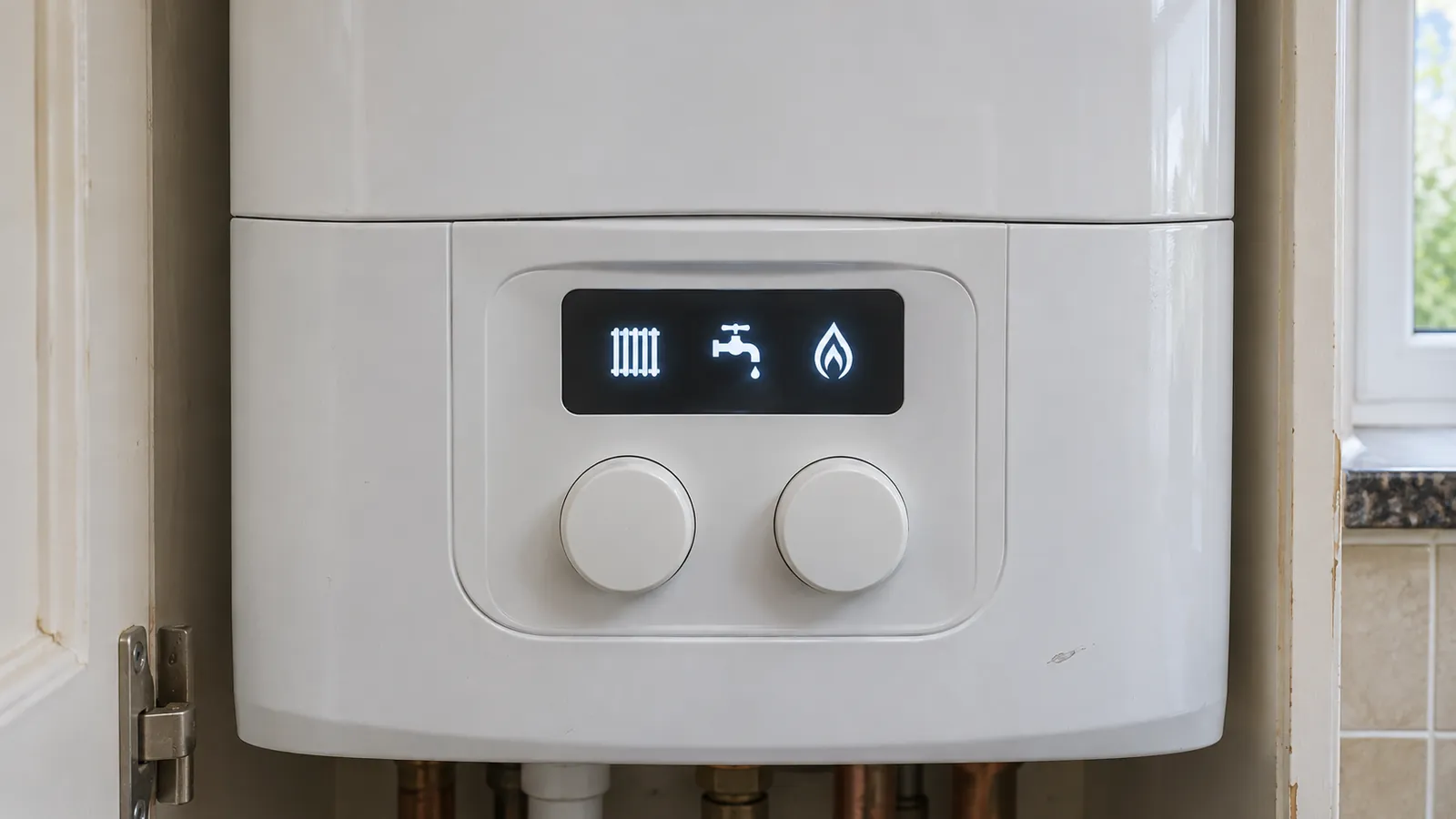
- Two dials or two temperature settings (one with a radiator symbol, one with a tap symbol): typical of a combi, which controls heating and hot water separately.
- One dial for heating only: common on regular and system boilers, with the hot water controlled by a separate programmer and cylinder thermostat.
This isn't a perfect test, because some system boilers also show a tap setting, but together with the cylinder check it's a strong clue.
Count the pipes underneath
You don't need to be a plumber. Look at the pipes coming out of the bottom of the boiler:
- Combis usually have five pipes: heating flow and return, cold mains in, hot water out, and gas. There's usually a filling loop too, often a silver braided hose or a lever.
- System and regular boilers usually have fewer pipes (often four or fewer, including gas), because there's no mains hot water connection.
Every installation is different, so treat this as a guide, not proof.
Look outside at the flue
A plume of white "steam" from the flue on a cold day is just water vapour. That's a sign of a condensing boiler, which we explain below. There will also be a thin plastic condensate pipe (usually white or grey, about 21–32 mm wide) running from the boiler to a drain.
Step 4: Find the make, model and GC number
The data badge (also called the data plate or rating label) tells you exactly what you've got. Look:
- behind the front flap or the drop-down panel on the front
- on the underside of the boiler
- on the side, especially if the boiler is in a cupboard
Write down:
- Manufacturer, for example Worcester Bosch, Vaillant, Ideal, Baxi, Viessmann or Glow-worm
- Model name, such as Greenstar 4000, ecoTEC plus or Logic Max Combi2
- Output in kW, for example 25 kW or 30 kW
- GC number (Gas Council number), a seven-digit code like 47-XXX-XX. Engineers and parts suppliers use it to identify the exact model
- Serial number, which often contains the manufacture date
The model name often tells you the type directly. Words like "Combi", "System" or "Heat Only" (or "Regular") are common in model names.
The data badge is on the outside of the boiler or behind a flap you can open by hand. Never remove screws or the inner casing to find it. Only a Gas Safe registered engineer should open the sealed part of a gas boiler. Smell gas? Leave the building and call the National Gas Emergency number on 0800 111 999.
No badge you can find?
Check the user manual, the Benchmark checklist left by the installer, or the gas safety record from your last service. Your installer also had to register the boiler under Building Regulations, so the Building Regulations compliance certificate for the installation lists it too.
How old is my boiler?
There's no single label that says "made in…", but you can usually narrow it down:
- Paperwork: the installation date is on the Benchmark checklist, the compliance certificate or old service records.
- Serial number: many manufacturers encode the manufacture date in the serial number. The manufacturer's customer service team can usually decode it for you.
- Design clues: a large, floor-standing boiler or one with a visible pilot light is likely to be decades old.
- Condensing or not: since 1 April 2005, almost all new gas boilers fitted in England and Wales have had to be condensing (a similar rule for oil boilers followed in 2007). A non-condensing gas boiler is likely to be from before then.
Most modern boilers last somewhere around 10 to 15 years with regular servicing, though many run longer. Age on its own isn't a reason to replace a boiler that's working safely, but it's useful context when you get repair quotes.
Condensing or non-condensing?
A condensing boiler captures extra heat from its exhaust gases. As those gases cool, water vapour condenses, which is why you see:
- a white plume from the flue in cold weather
- a plastic condensate pipe running to a drain or soakaway
Non-condensing boilers have no condensate pipe and are usually older, with metal flues, often in a balanced flue on the outside wall or into a chimney.
If you have a condensing boiler, how you set the temperature makes a real difference to how efficiently it runs. We explain the settings in our guide to boiler temperature.
In very cold weather a condensate pipe that runs outside can freeze and stop a condensing boiler working, often with a fault code. If that happens, see your manufacturer's advice on thawing it with warm (not boiling) water.
What about back boilers?
A back boiler sits behind a gas fire in the fireplace, usually in the chimney breast in a living room. They were common from the 1960s to the 1980s. Signs you have one:
- a gas fire with a separate set of boiler controls on or near it
- no boiler on any wall in the kitchen or elsewhere
- a hot water cylinder and loft tanks, because back boilers work like regular boilers
Back boilers are very old now and non-condensing, so they're generally much less efficient than a modern boiler. If yours is still running, keep the annual gas safety check up to date. Replacing one is a bigger job than a normal swap because the new boiler usually goes somewhere else and the fireplace is made good. You'll find more in our heating guide.
Solid-fuel stoves and log burners can also have a back boiler for hot water. These aren't gas appliances, but they still need a competent installer and HETAS-registered work for solid fuel.
Why your boiler type matters
For troubleshooting
- Combi with no hot water and no heating? Check the pressure first. Low pressure is the most common cause. See why a combi boiler loses pressure.
- Regular or system boiler with heating but no hot water? The problem may be the cylinder, its thermostat, the motorised valve or the programmer, rather than the boiler.
- Fault code on the display? The code meanings depend on the make. For example, see our list of Vaillant boiler fault codes.
For replacement quotes
Installers will ask what you have now. Swapping like for like is usually simplest. Changing from a regular boiler to a combi often means removing the cylinder and loft tanks, moving pipework and possibly a new gas pipe, so it costs more but frees up the airing cupboard.
A combi suits homes where one tap or shower runs at a time and the mains water pressure and flow are good. Homes with two or more bathrooms used at once often work better with a system boiler and cylinder.
For your energy bills
Your boiler type affects how and when you heat water. With a cylinder you might also be able to use an immersion heater on a cheap overnight tariff. Check whether that actually saves money with our guide to Economy 7 and storage heaters.
Quick checklist
Run through these in order:
- Turn on a hot tap with the heating off. Instant hot water and no cylinder in the house = combi.
- Find the cylinder. If there's one, it's a system or regular boiler.
- Check the loft. Two tanks (one large, one small) = regular. No tanks = system.
- Check for a pressure gauge. A gauge suggests combi or system; usually none on regular.
- Read the data badge for the make, model, kW and GC number.
- Look outside for a plume and a plastic condensate pipe to see if it's condensing.
FAQs
How do I know if my boiler is a combi?
A combi has no hot water cylinder and no water tanks in the loft. Hot water comes straight from the boiler, which fires up as soon as you open a hot tap. Most combis have a pressure gauge and two temperature controls, one for heating and one for hot water.
What is the difference between a combi boiler and a system boiler?
Both are sealed, pressurised systems with no loft tanks. A combi heats water instantly from the mains as you use it. A system boiler heats water and stores it in a cylinder, so several taps and showers can run at once.
What is a regular boiler?
A regular boiler, also called a conventional, heat-only or open-vent boiler, works with a hot water cylinder plus a cold water tank and a small feed-and-expansion tank in the loft. It's common in older homes.
Where is the GC number on my boiler?
On the data badge, which is usually behind the front flap, on the underside or on the side of the boiler. It's a seven-digit number, often written like 47-XXX-XX. It's also in the user manual and on the Benchmark checklist.
How can I tell how old my boiler is?
Check the installation paperwork, gas safety records or Benchmark checklist. If you have none, give the serial number from the data badge to the manufacturer, who can usually tell you when it was made.
Is my boiler condensing?
If there's a plastic condensate pipe running from the boiler to a drain, and the flue puffs out a white plume on cold days, it's a condensing boiler. Almost all gas boilers fitted in England and Wales since April 2005 are condensing.
Do I have a back boiler?
If there's no boiler on any wall but you have a gas fire in the living room with boiler controls nearby, plus a hot water cylinder and loft tanks, you probably have a back boiler behind the fire.
Can I change from a regular boiler to a combi?
Usually, yes, but it's a bigger job than a straight swap: the cylinder and tanks are removed and pipework changed. A Gas Safe registered engineer will check your mains water pressure and flow first, because a combi needs good mains supply to work well.
- No cylinder and no loft tanks = combi. Cylinder but no tanks = system. Cylinder and two loft tanks = regular.
- The data badge shows the make, model, output and GC number. Never open the casing to find it.
- A plastic condensate pipe and a white plume mean a condensing boiler.
- Your boiler type decides how you troubleshoot it, what replacements suit you and how you heat your water.