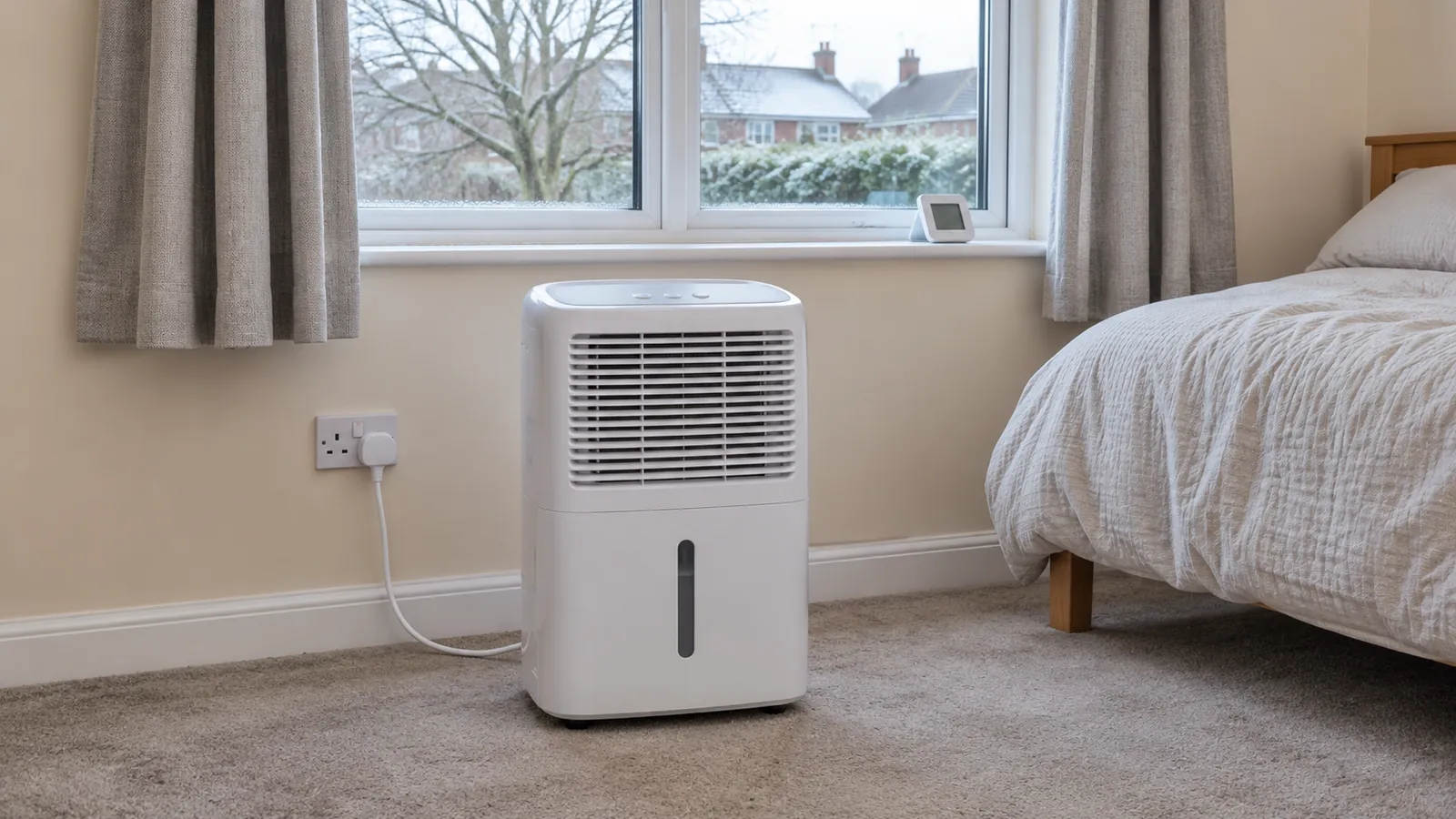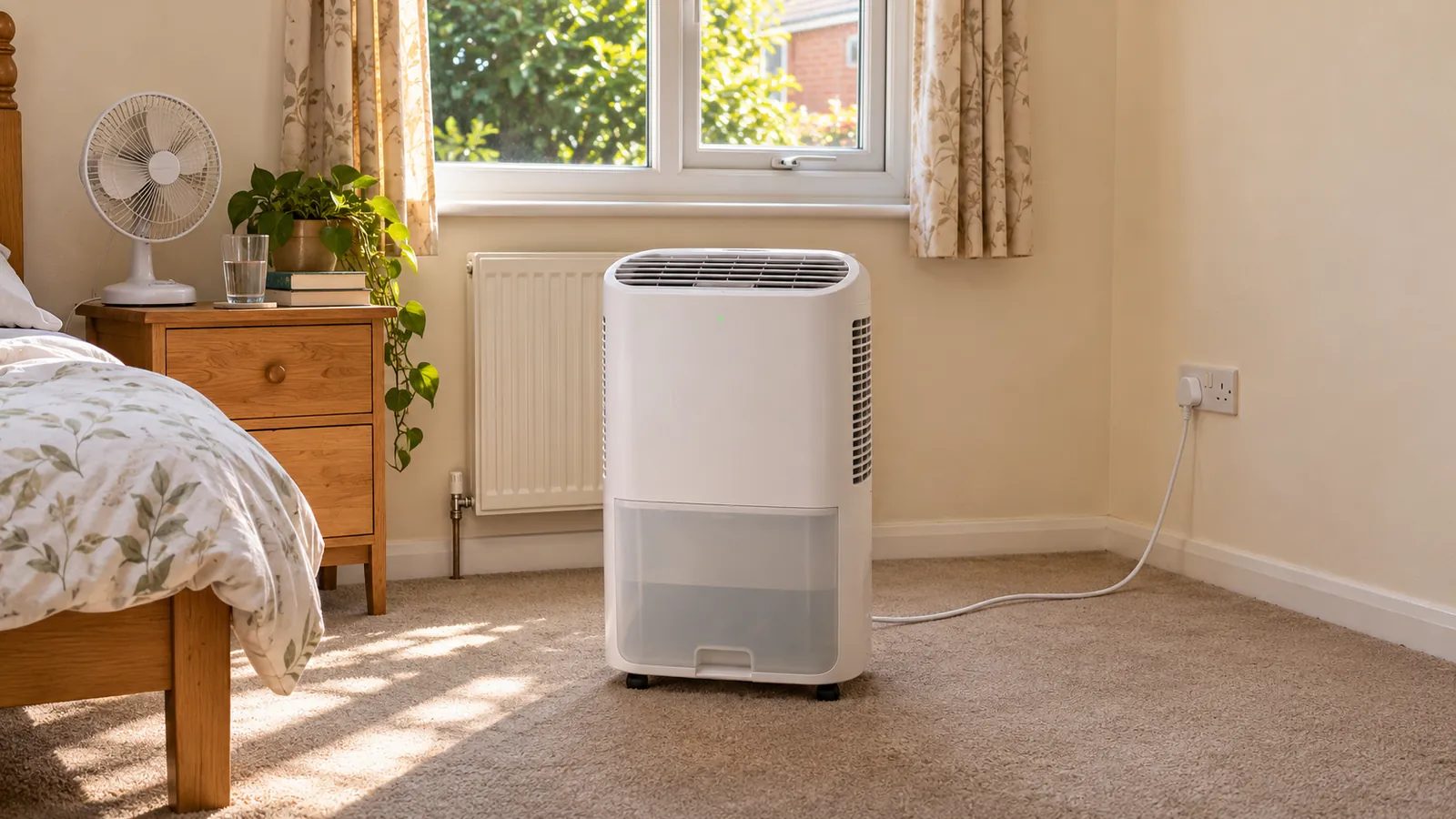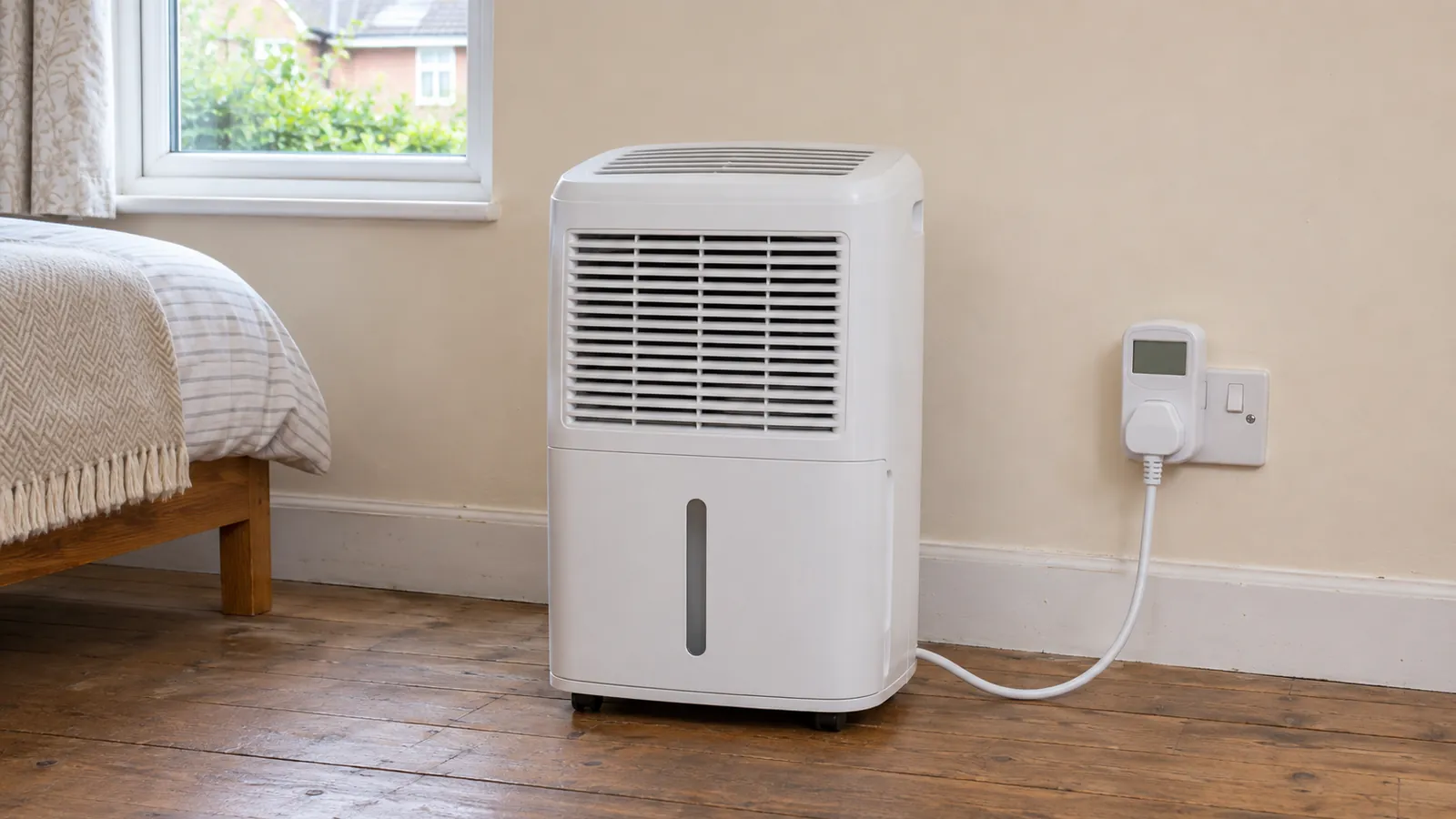

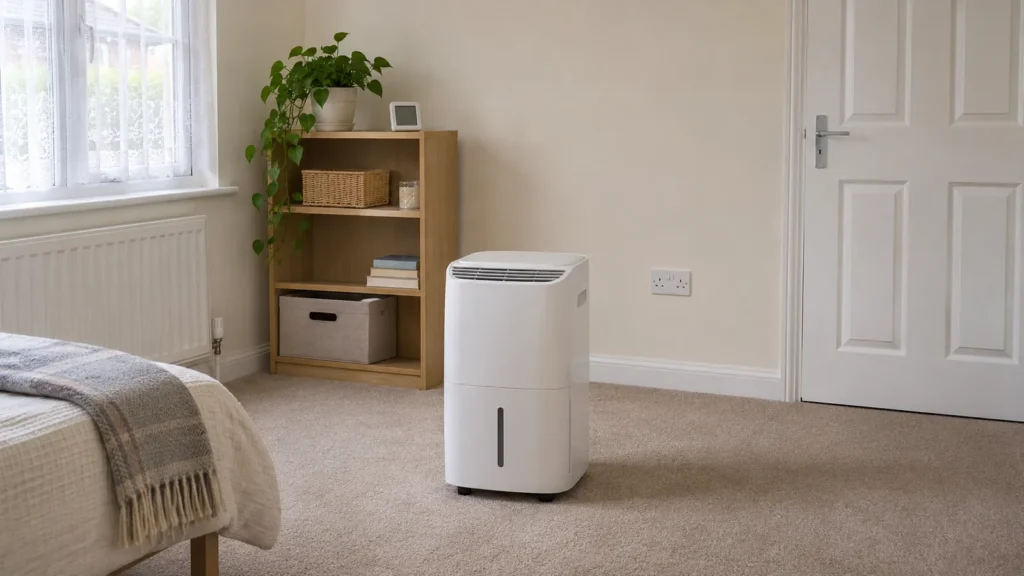
The best place for a dehumidifier is in the room with the moisture problem, or somewhere central like a landing or hallway with the internal doors open, about 30cm clear of walls and furniture. Set the humidistat to around 50–55% (drop to 40–45% if windows still run with condensation in winter), keep external doors and windows shut, and empty the tank or use the drain hose. It's fine to leave one running overnight: a typical compressor model costs roughly 30–60p for eight hours.
Most people buy a dehumidifier, stick it in the nearest corner, and wonder why the windows are still wet a week later. Position, settings and shut windows matter more than the model. A good machine in the wrong place does very little. If you're fighting damp and mould in the first place, the machine manages the air but doesn't fix a leak, so check that too.
Where to put a dehumidifier
Two sensible options, depending on what you're dealing with.
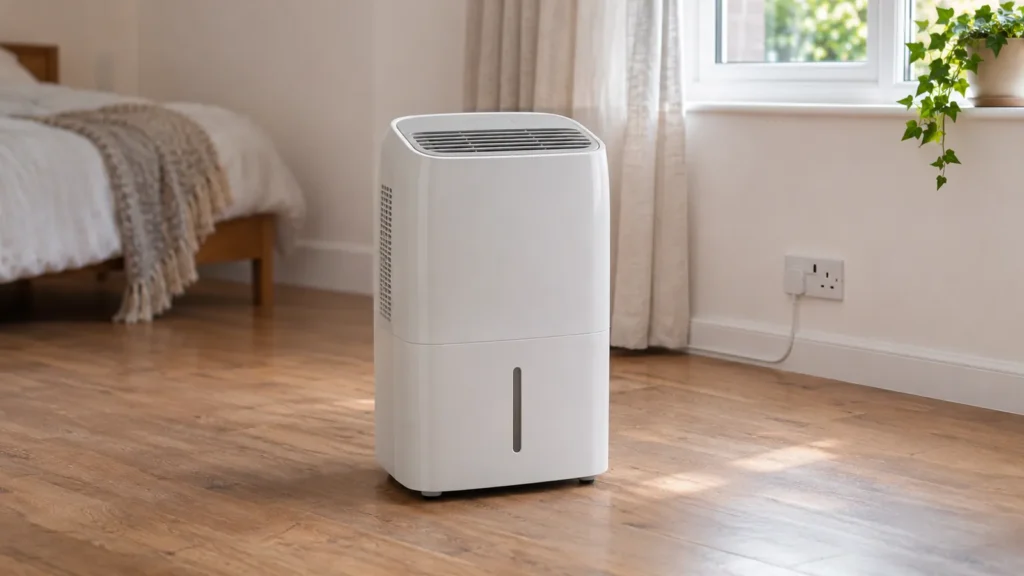
One damp room. Put it in that room (the bedroom with black spots on the outside wall, the box room where you dry washing), shut the door, and let it work on a small volume of air. This is also the right move for drying laundry. We cover timings in does a dehumidifier dry clothes.
A generally damp house. Meaco's own advice is a central spot near your main moisture sources, a landing being their example for bathroom steam, with internal doors left open so damp air drifts towards the machine. They also say to leave it in one place rather than carrying it from room to room. A machine that keeps getting moved never gets the humidity down properly.
Some practical rules that most manufacturer manuals repeat in one form or another:
- Leave around 30cm of clear space around the air intake and outlet. Meaco notes that most models need this, with a few (like its Arete range) happy sitting flush to a wall. Check your manual.
- Not in a bathroom or anywhere that can get splashed. Put it on the landing or in the hallway and let it pull the steam out. Don't stand it in a shower room.
- Not behind a sofa, under a curtain or in a cupboard. Blocked airflow means little water collected, a noisier fan and a hotter machine.
- On a flat, hard surface. Wobbly floors can trip the tank float switch and the machine will cut out.
- Away from the wall that's wet, not against it. Standing it tight to a damp wall does nothing special; air movement across the whole room does the work.
If you've only got a drain hose and one sink, that may decide for you. In a kitchen or utility, putting the machine on a worktop next to the sink means a hose can run straight into it.
Not sure which room is worst? Buy a £5–10 hygrometer (the little digital humidity gauge) and leave it in each room for a day. Where it reads over 65% most of the time is where the machine goes.
Doors and windows: shut or open?
Both, depending on which door.
For a single-room job, shut that room's door and window. You're trying to dry a small box of air, and an open window feeds in damp air as fast as you can take it out. This matters especially in a winter UK house where outside air is often 80–90% humid.
For a whole-house setup, keep external doors and windows shut but internal doors open, per Meaco, so moisture can travel to the machine. Air the house briefly (10 minutes with windows wide open) once or twice a day, then shut up again and let the dehumidifier recover.
What humidity to set a dehumidifier to
Most advice lands in the same place. Meaco's guidance is to aim for 50–55% relative humidity, with a general recommendation of 55%, and to go down to around 40% in the colder months if windows still stream with condensation. Mould tends to take hold above about 60–65% over time, which is why the sensible band is 40–60%.
On Mumsnet and Reddit the threads are in the same ballpark. Someone suggests starting at 55–60% and lowering it if condensation shows, another says run it 24/7 at 60% for a week and see. That's reasonable. Going lower than you need just burns electricity, because the machine runs flat out trying to hit a figure your home can't sustain.
A rough way to set it:
- Put a hygrometer in the room and note the starting reading.
- Set the humidistat to 55%.
- Check windows in the morning. Still wet or misty? Drop to 50%, then 45% a few days later.
- Dry windows and a reading under 60% means you're done. Leave it there.
Don't expect the number on the dial to match your hygrometer exactly. Built-in sensors are approximate, usually by a few percentage points, so trust a separate gauge if they disagree. And if the machine can't get near the target after a day or two, the likely reasons are: windows left open, a cold room (compressor models struggle below about 15°C, see desiccant vs compressor dehumidifier), a machine too small for the room, or a source like a leak that keeps adding water.
Can you leave a dehumidifier on all night?
Yes. They're built to run for hours, and the humidistat switches the compressor off when the room hits its target. Meaco's "control logic" description is typical: slow the fan as humidity nears the target, switch off, check the air every 30 minutes, and restart only if humidity rises by more than 5%. The tank also has a float switch that stops the machine when it's full.
Three things to check before you do:
- Noise. A compressor model usually sits somewhere around 35–45dB on low, which is about a quiet-library hum. Some people find that fine, others don't. Look for a sleep or night mode, which drops the fan speed and sometimes dims the lights.
- Cable and plug. Plug straight into a wall socket where you can. If you have to use an extension, use one that's fully unwound and rated for the load, and never run the cable under a rug. The manual will probably say not to use extension leads at all.
- Tank or drain. An 8-hour night can fill a small tank, and then the machine stops with nothing done for the second half. Either empty it before bed or use continuous drainage.
What does it cost? At the Ofgem price cap average of 26.32p/kWh:
| Machine power | 8 hours | Energy | Cost |
|---|---|---|---|
| 160W (small compressor) | 8 hrs | 160W × 8 = 1.28kWh | 1.28 × 26.32p = about 34p |
| 250W (20L compressor) | 8 hrs | 250W × 8 = 2.0kWh | 2.0 × 26.32p = about 53p |
| 400W (desiccant) | 8 hrs | 400W × 8 = 3.2kWh | 3.2 × 26.32p = about 84p |
And those are maximums, because the compressor cycles off once the target is met. Running 24 hours straight at 200W would be 4.8kWh, about £1.26 a day, though in practice it won't run flat out all that time. To work out your own machine, use the dehumidifier running cost calculator with the wattage printed on the rating label.
Never cover a dehumidifier, never dry clothes directly on top of it, and unplug it before you clean it or move it. If the cable or plug gets hot, smells of burning or the machine trips the fuse, stop using it and get it checked by an electrician or the manufacturer.
Continuous drainage
If you're emptying a 2–5 litre tank every day, set up the drain hose. Many models come with a hose port, either in the back or the tank bay.
The rules are simple. The water drains by gravity, so the hose must run downhill from the outlet to wherever it ends, with no kinks or dips where water can sit. The end must be lower than the outlet. A sink, shower tray or a bucket that's lower than the machine all work. If you've got to go uphill, you need a model with a built-in pump, or a separate one.
Kitchens and utility rooms next to a sink are the easy case. For bedrooms it often means the hose runs to a bucket, and then you're emptying the bucket instead, so a bigger tank may be more sensible.
Using a dehumidifier on a damp wall
A dehumidifier dries the air, and wet walls then give up moisture into that dry air. It helps with condensation damp, laundry-damp rooms and a house that's just a bit humid. It won't cure rising damp or penetrating damp, because both are being topped up from outside the wall. See our guides on rising damp and how to fix damp to work out which you have.
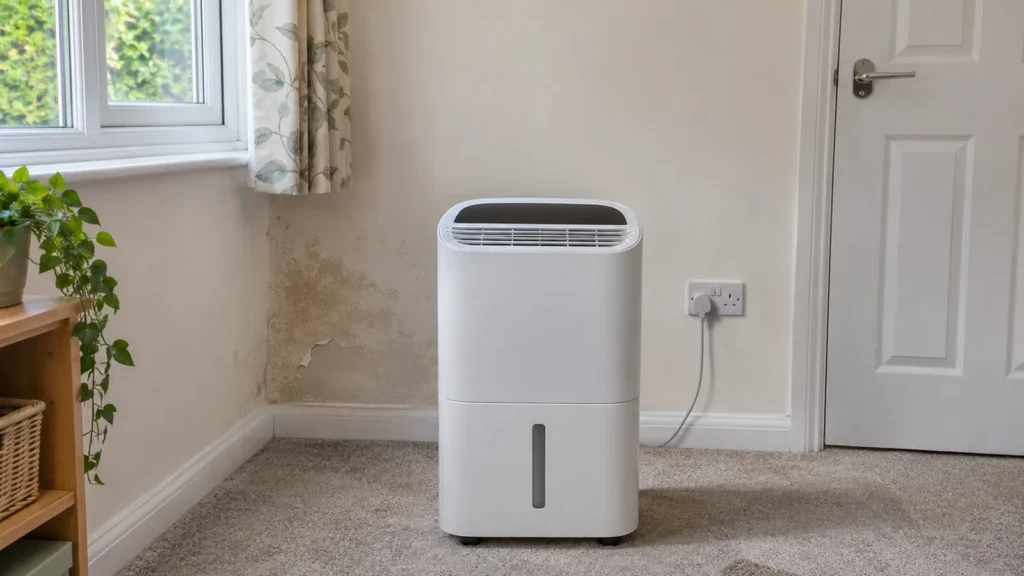
How long to dry a damp wall? There's no honest single answer. A wall that got wet from a one-off leak, once the leak is fixed, may dry over weeks, and a thick solid wall can take months. A wall with ongoing damp doesn't dry at all while the source remains. Use a moisture meter (or a surveyor with one) to track progress, and don't repaint or replaster until readings have fallen.
Using a dehumidifier to dry new plaster
Here the common instinct is wrong. People assume more drying equals better, and then blast the room. Plasterers and several UK forum answers push the other way: plaster that dries too fast can crack or go crumbly, because it needs to cure rather than simply lose water. The steer from most sources is to let it dry gradually with ventilation, and to use a dehumidifier gently, if at all, after the plaster has begun to set.
Rough timescales vary with thickness and backing, and they come from forum and trade pages rather than a standard, so treat them as a guide:
- A thin skim coat often looks dry in a few days, but it's usually safest to wait about two weeks or more before painting.
- Thicker multi-coat or backing plaster tends to need longer, often a few weeks.
- Some trade advice is to wait around four weeks before applying a full paint system.
Look for the colour change: wet plaster is dark and patchy, and when it has dried it goes an even pale pink (or pale, depending on the product). Once it's even, a mist coat of thinned emulsion is the usual first step. Your plasterer will know the product, so follow their instructions over mine. If the walls feel damp for months, that's a sign of a moisture source rather than slow drying.
Emptying the tank and cleaning the filter
- Empty the tank daily when it's in use, or when the "tank full" light comes on. Rinse it now and then with warm water and a little washing-up liquid; stagnant water can smell.
- Clean the dust filter every couple of weeks in use. Meaco warns that a clogged filter makes the machine work harder, raising energy use and noise. Most are a mesh you can pull out, tap, vacuum or rinse, then dry fully before refitting.
- HEPA filters, if fitted, are replaced rather than washed. Meaco says to swap them once they've gone from white to dark grey.
- Water from the tank isn't for drinking. Don't put it on houseplants or in a kettle or iron, as it can contain dust and metal traces from the coils.
If it's collecting less than it used to, check the filter first, then whether the room's got colder, then whether ice has formed on the coils.
FAQs
How long does a dehumidifier take to dry clothes?
Around 4–8 hours for a normal load in a small closed room, depending on the machine and room. Our dehumidifier and clothes guide has a table of times and costs.
Is it okay to run a dehumidifier in the bedroom at night?
Yes, if you've got a quiet or sleep mode and the cable is safe. Make sure the tank can last the night or use a drain hose, and don't block the vents with bedding or curtains.
Should I keep the dehumidifier on 24 hours a day?
Not necessarily. In a damp house over winter, many people do run them continuously on a humidistat, and the machine switches itself off when the target is reached. Once readings are steady below 60%, you can drop to a few hours a day.
Why is my dehumidifier running but the tank is empty?
Usually the room is too cold (below about 15°C for a compressor model), the humidity is already below the target, or the filter is blocked. A desiccant type may suit cold rooms better.
Does a dehumidifier cool or heat the room?
It warms the room slightly, usually by a degree or two, because the machine's motor and compressor give off heat. It won't replace the heating.
- Put it in the damp room, or centrally with internal doors open, about 30cm from walls.
- Shut windows and external doors; set it to roughly 50–55%, lower in winter if windows still condense.
- Overnight running is normal: about 34–84p per 8 hours depending on the model.
- It dries air and surfaces, not a wall that's being fed by a leak or rising damp.
- On new plaster, let it dry gradually and follow your plasterer's advice.