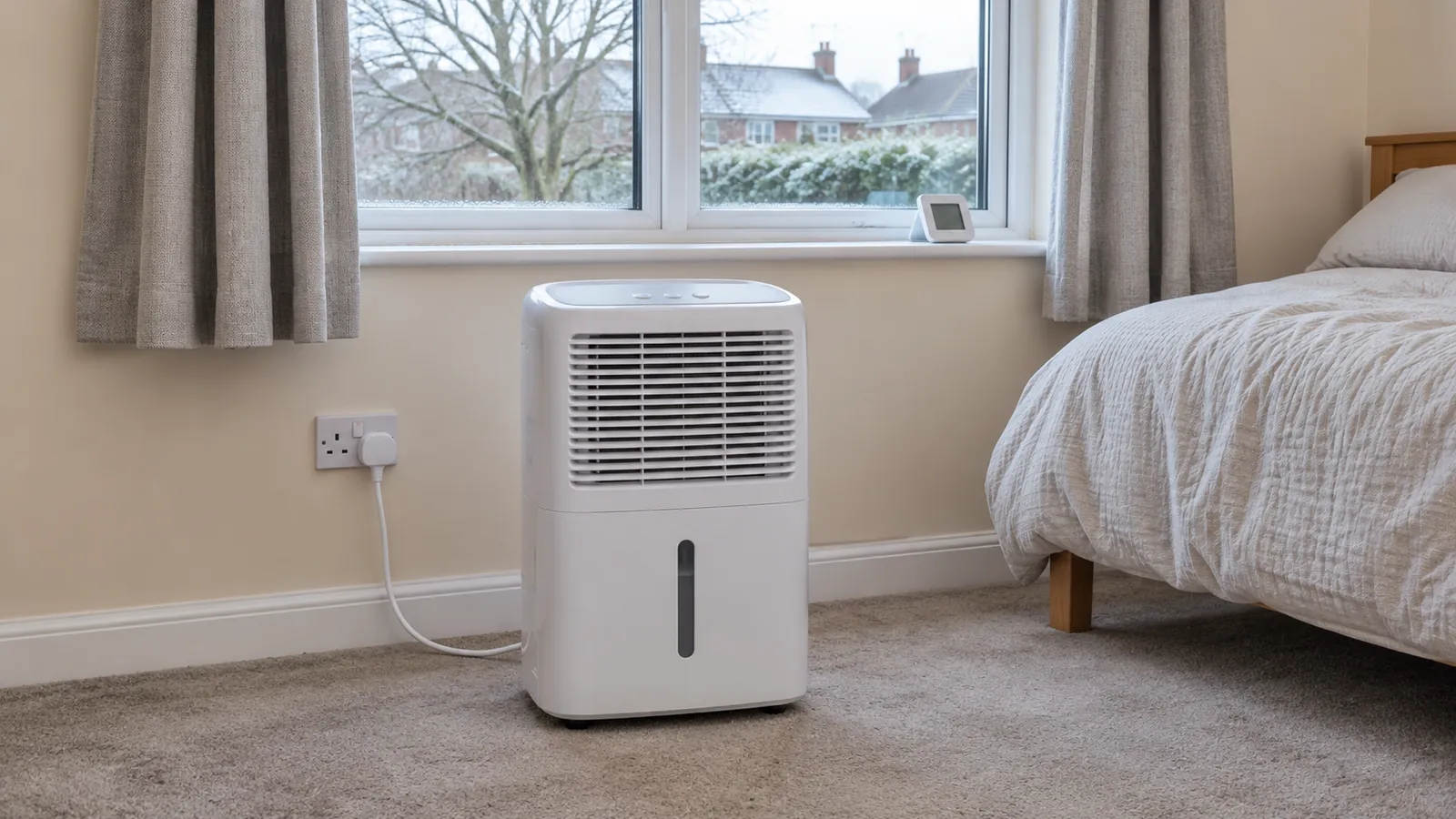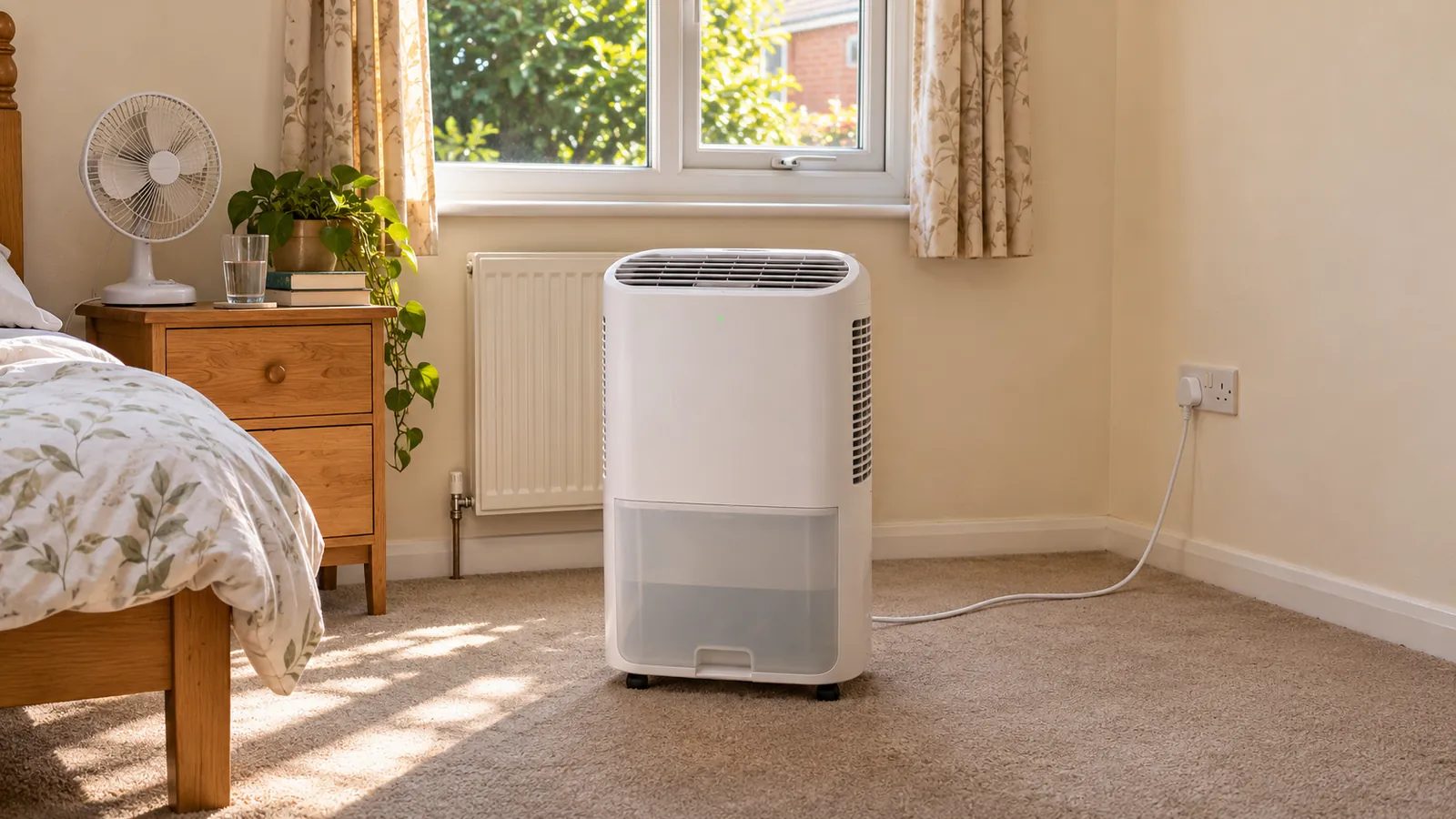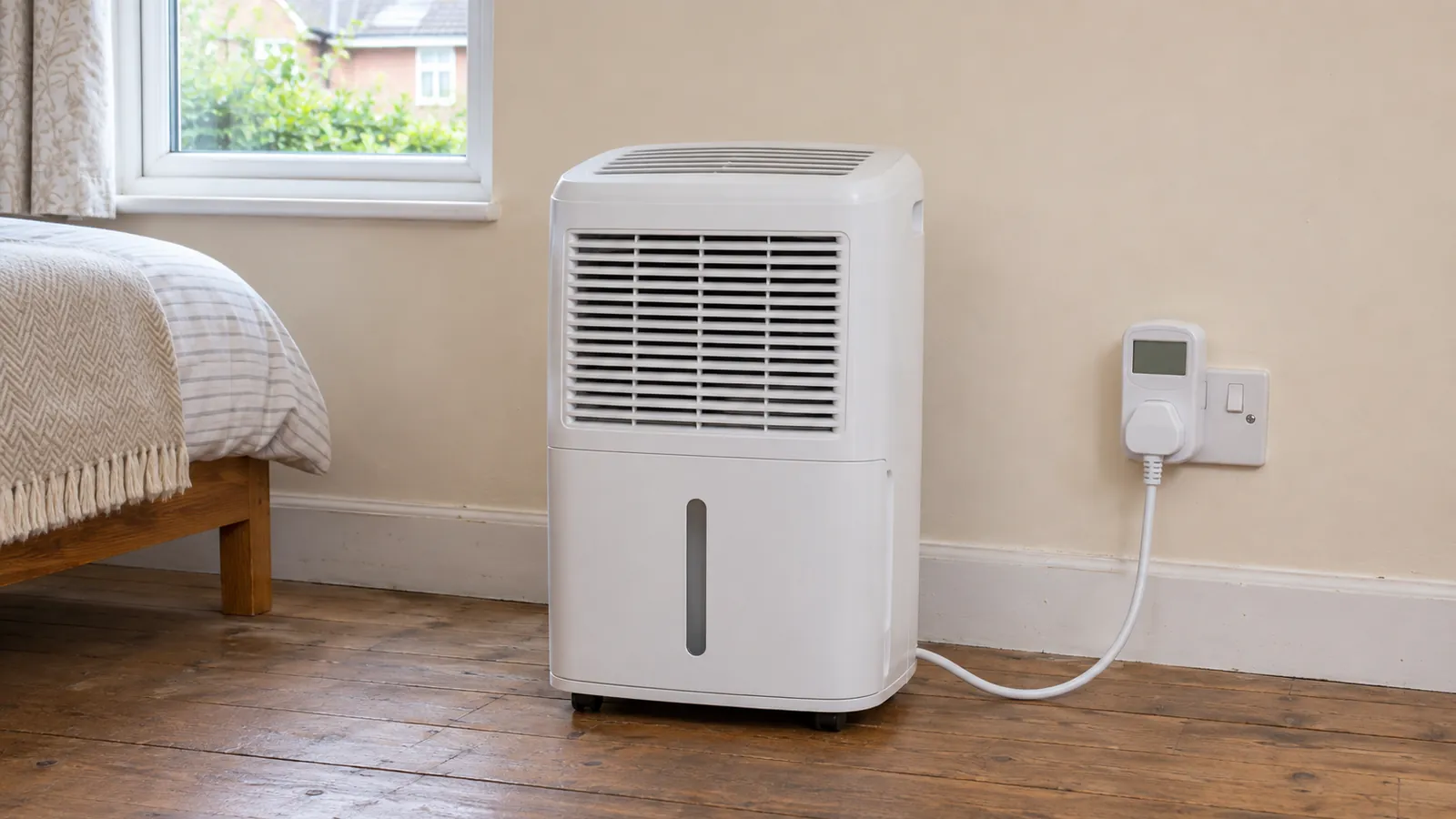

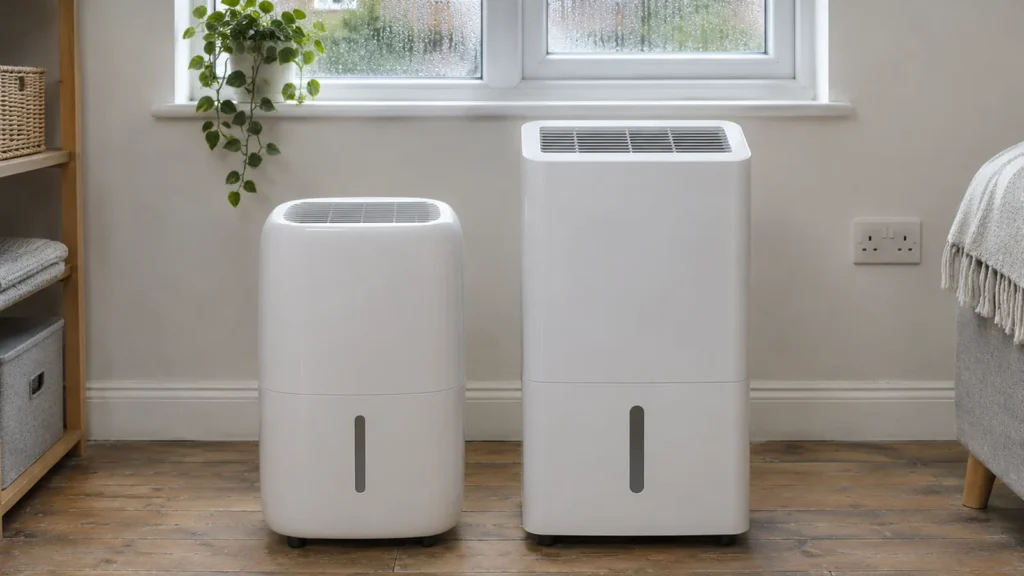
Choose a compressor dehumidifier for heated rooms and a desiccant dehumidifier for cold ones. Compressor models are cheaper to run (often around 150–250W) and work best when the room is above about 15°C. Below that they slow down and spend time defrosting. Desiccant models use more power (often around 300–650W) but work almost the same whatever the temperature and give off gentle heat, so they suit garages, conservatories, unheated bedrooms, boats and caravans. Most UK homes kept at normal living temperatures are best served by a compressor model.
Picking a dehumidifier is one of the best things you can do about condensation and mould, but the two main types behave very differently. Buy the wrong one and you either pay more than you need to on electricity, or end up with a machine that barely collects any water in a cold room. For the bigger picture on damp, start with our complete guide to damp and mould.
How a compressor dehumidifier works
A compressor (or refrigerant) dehumidifier works like a small fridge. A fan pulls room air over a set of very cold metal coils. The water vapour in the air condenses on the coils, like droplets on a cold can of drink, and drips into the tank. The air is then passed over warm coils and blown back into the room, slightly warmer than it went in (usually by only a degree or two).
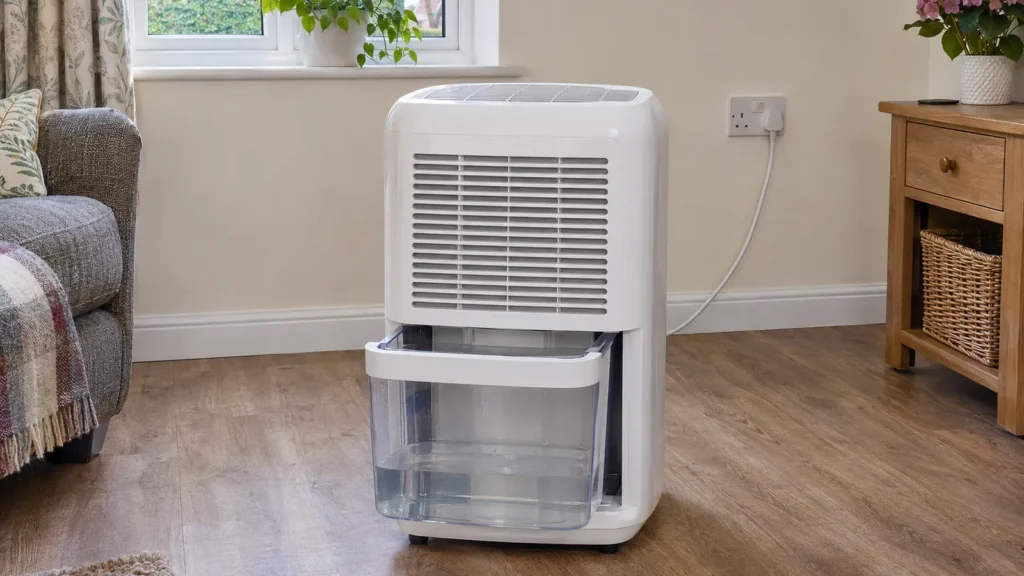
Strengths:
- Low running costs for the amount of water removed in a warm room
- High extraction in normal living temperatures
- Widely available in 10, 12, 20 and 25 litre sizes
Weaknesses:
- Performance drops as the room gets colder
- Heavier, because of the compressor
- Can hum or vibrate when the compressor kicks in
Why compressors struggle in cold rooms
When the room is cool, the cold coils can drop below freezing and ice over. The machine then has to stop dehumidifying and run a defrost cycle. Dehumidifier makers generally put the point where this starts to matter at around 10–15°C. Below that, a compressor model spends a growing share of its time defrosting instead of drying, and in a garage near 5°C it may hardly collect anything.
How a desiccant dehumidifier works
A desiccant dehumidifier uses a slowly turning wheel coated in a moisture-absorbing material (usually zeolite, a mineral a bit like the silica gel sachets in new shoes). Room air passes through the wheel, which soaks up the water vapour. A small built-in heater then warms one section of the wheel to drive the water back out, and this moisture is condensed and drained into the tank.
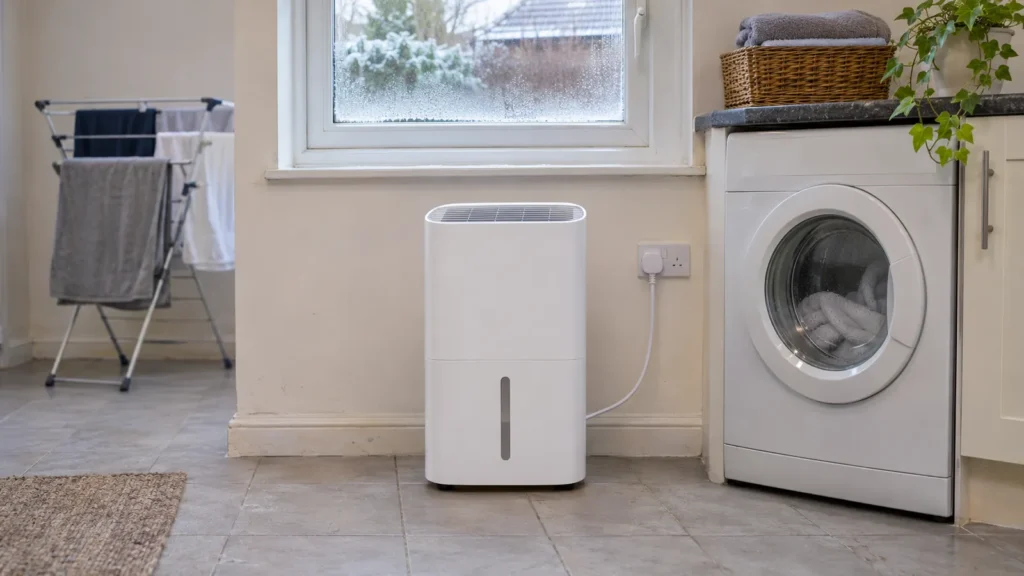
Strengths:
- Works almost the same at 5°C as it does at 20°C, because it doesn't rely on cold coils
- Lighter and often quieter, with no compressor
- Blows out noticeably warm air, typically around 10°C warmer than the room, which helps in cold spaces and with drying laundry
Weaknesses:
- Uses more electricity, because of the internal heater
- Usually smaller extraction ratings than big compressor models
- The warm output can make a small, already-warm room feel stuffy in mild weather
That extra warmth isn't wasted. In a cold room, the heat from a desiccant dehumidifier partly does the job a small heater would otherwise do. In a room you're already heating, though, it's just extra electricity.
Desiccant vs compressor at a glance
| Compressor | Desiccant | |
|---|---|---|
| Best room temperature | Above about 15°C | Any, including below 10°C |
| Typical power use | ~150–250W | ~300–650W (depending on setting) |
| Air coming out | Slightly warmer (about +1–2°C) | Much warmer (about +10°C) |
| Weight | Heavier (often 10–15kg) | Lighter (often 6–8kg) |
| Noise | Fan plus compressor hum | Fan only, usually quieter |
| Works in a garage in winter? | Poorly | Yes |
| Running cost in a heated home | Lower | Higher |
| Good for drying laundry? | Yes, cheapest in a warm room | Yes, faster in a cold room |
Running costs: the real maths
Running cost depends on the wattage and how long the machine runs. The formula is:
Watts ÷ 1,000 × hours × price per kWh = cost
Using the current average unit rate of 26.32p per kWh (Ofgem price cap average, 1 Oct–31 Dec 2026):
| Dehumidifier and setting | Power | Cost per hour | Cost for 8 hours |
|---|---|---|---|
| Small compressor (10–12L) | 160W | 4.2p | 34p |
| Large compressor (20L) | 250W | 6.6p | 53p |
| Desiccant, normal setting | 330W | 8.7p | 69p |
| Desiccant, high or laundry setting | 650W | 17.1p | £1.37 |
Worked example for the large compressor: 250 ÷ 1,000 × 8 × 26.32p = 52.6p.
These are figures for the machine running flat out. In practice, most dehumidifiers have a humidistat: once the room reaches the humidity you set (around 50–55% is a good target), they slow down or pause, so your real daily cost is often lower.
Try your own numbers, with your own unit rate and hours, in our dehumidifier running cost calculator.
Dehumidifier running cost calculator
– · Default price: Ofgem price cap average, 1 Oct–31 Dec 2026. Check your bill for your exact unit rate.
Is a compressor always cheaper?
In a heated room, yes, usually by a clear margin. In a cold room it's closer than the wattage suggests. A compressor model running at 8°C may use its full power while collecting only a small amount of water, because much of its time goes on defrosting. A desiccant model in the same room keeps collecting water steadily, so its cost per litre of water removed can end up similar or even better, and you get some warmth too.
Extraction rates and capacity labels explained
Dehumidifiers are sold by a "litres per day" figure, such as 10L, 12L or 20L. This is the most water the machine can remove in 24 hours, but it's usually measured in hot, very humid test conditions: 30°C and 80% relative humidity. Very few UK homes are anything like that.
At more typical indoor conditions, around 20°C and 60% humidity, a compressor model removes far less. One manufacturer's own figures show its "20 litre" compressor model removing around 8 litres a day at those conditions, well under half its headline rating. Independent consumer testing overseas has found similar gaps between claimed and real-world extraction.
What this means when you shop:
- Don't compare a compressor and a desiccant model on the headline litres alone. A 7–8L desiccant can match or beat a 12L compressor in a cold room, because the desiccant figure holds up when it's cold and the compressor figure doesn't.
- Look for a second figure at lower conditions (often 20°C/60% RH, sometimes lower). Some makers publish it on the spec sheet or in the manual.
- Tank size is different from extraction rate. A 2L tank on a 12L machine just means you empty it more often. If you'll run it a lot, look for continuous drainage (a hose outlet) instead.
Noise and weight
- Compressor models have a fan plus the compressor, which can hum and vibrate. Many have a quieter night mode, but some still click as the compressor starts and stops. Weight is often 10–15kg, so look for wheels and a handle if you'll move it between rooms.
- Desiccant models are mostly just fan noise, often softer and steadier, which some people find easier to sleep with. They're lighter, so they're easier to carry up and down stairs or into a boat or caravan.
Check the manufacturer's stated noise in decibels (dB) on the lowest setting if the machine will live in a bedroom.
Which type should you choose? By room and use
| Where or what | Best type | Why |
|---|---|---|
| Heated flat or house (rooms 18–21°C) | Compressor | Lowest running cost in warm rooms |
| Bedroom kept cool overnight (below about 15°C) | Desiccant | Keeps working in the cold, quieter |
| Drying laundry in a warm room | Compressor with laundry mode | Cheapest per load |
| Drying laundry in a cold room or with heating off | Desiccant | Works in the cold, warm air speeds drying |
| Garage, shed, workshop, outbuilding | Desiccant | Compressors barely work near 5°C |
| Unheated conservatory | Desiccant | Cold nights and mornings |
| Boat or caravan in winter storage | Desiccant | Light, works in the cold, protects against frost-related condensation |
| Cellar or basement (cool, very damp) | Large compressor if it's above about 12–15°C, otherwise desiccant | Depends on the temperature, so measure it |
| Whole-house mould problem, heating on | 20L compressor | Can handle the volume of moisture at a low running cost |
Not sure how cold the room actually gets? Put a cheap thermometer-hygrometer (often under £10) in it for a week. If it regularly reads below about 15°C, lean towards a desiccant. If it sits around 18–21°C, choose a compressor. It also tells you whether humidity is really the problem: aim for 40–60%.
Drying clothes
Both types dry laundry well in a small closed room. Read our guide to whether a dehumidifier dries clothes for drying times and cost per load. If you also use a heated clothes airer, pairing it with a dehumidifier stops all the moisture from your washing ending up on your windows.
Condensation and mould
If you're fighting condensation on the inside of your windows or mould on a bathroom ceiling, a dehumidifier helps a lot, but it works alongside ventilation and steady heating, not instead of them. Running one in a sealed, unheated room is a common reason for disappointing results with compressor models.
Best desiccant dehumidifier features to look for
We don't name "best buy" models, because we haven't lab-tested them. What separates a good desiccant dehumidifier from a frustrating one:
- A humidistat with a target setting, so it eases off when the room is dry and doesn't run at full power all day
- More than one power setting (an economy or low setting, plus a high or laundry setting)
- A low-temperature extraction figure on the spec sheet, not just the headline rating
- Continuous drainage if it's going in a garage, boat or cellar where you won't empty the tank daily
- Auto-restart after a power cut, useful for garages and stored caravans
- Tip-over and overheat protection, important given the internal heater
- A washable dust filter that's easy to reach
- A frost watch or low-temperature mode on some models, which only switches on when needed in storage spaces
- A timer, so you can match running times to when the room is in use
For compressor models, also look at whether there's a laundry mode, a quiet or night mode, and wheels for moving it around.
Can you rent a dehumidifier in the UK?
Yes. Tool and equipment hire firms rent out larger dehumidifiers, usually by the day or week. This makes most sense for short, specific jobs, such as drying out a room after a leak or flood, helping new plaster dry, or clearing a damp problem while you fix the cause.
For ongoing condensation every winter, buying usually works out cheaper than renting for more than a few weeks. If the damp is from a leak or flood, check your home insurance first, because some policies cover drying equipment.
A dehumidifier treats the symptom, not the cause. If you have damp that's getting worse after rain, a tide mark low on the walls, or a patch that never dries, find out what kind of damp it is first. See how to fix damp.
Safety tips for both types
- Keep air vents clear: don't drape washing over the machine or push it against a wall.
- Stand it on a level, hard surface so it can't tip, and keep the tank seated properly.
- Plug it straight into a wall socket rather than a crowded extension lead, especially a higher-wattage desiccant model.
- Follow the manufacturer's guidance about bathrooms and wet areas.
- Clean the filter regularly; a clogged filter makes either type work harder and cost more.
FAQs
Is a desiccant or compressor dehumidifier better for a cold house?
If the rooms are regularly below about 15°C, a desiccant dehumidifier is usually better, because it keeps removing moisture in the cold and gives off some heat. If you heat the house to normal living temperatures, a compressor model is cheaper to run.
Do desiccant dehumidifiers use a lot of electricity?
They use more than compressor models: often around 300–650W depending on the setting, against roughly 150–250W for a compressor. At 26.32p per kWh, that's around 9–17p an hour at full power. A humidistat cuts this by easing off once the room is dry.
Which dehumidifier is best for a garage?
A desiccant dehumidifier, in most cases. Garages in a UK winter often sit around 5–10°C, where compressor models spend much of their time defrosting.
Can I use a compressor dehumidifier in a bedroom?
Yes, if the bedroom is reasonably warm. Look for a night or quiet mode. If you keep the bedroom cold overnight, a desiccant model may work better and is usually quieter.
Why is my compressor dehumidifier collecting hardly any water?
The room is probably too cold, or the air isn't very humid. Check the temperature and humidity with a hygrometer. If the room is below about 15°C, the machine may be spending most of its time defrosting.
Does a desiccant dehumidifier heat the room?
A little. The air it blows out is typically around 10°C warmer than the air it takes in, which noticeably warms a small room. It isn't a replacement for proper heating.
What size dehumidifier do I need?
For a flat or small house, a 10–12L compressor or a 7–8L desiccant model is usually enough. For a larger home, heavy laundry drying or a bad mould problem, a 20L compressor model handles more moisture. Remember that headline litre ratings are measured in hot, humid conditions.
- Room temperature decides it: compressor above about 15°C, desiccant below.
- Compressors cost less to run in warm rooms (around 4–7p an hour at 26.32p/kWh).
- Desiccants cost more (around 9–17p an hour) but keep working in garages, conservatories, boats and caravans.
- Headline "litres per day" figures are measured at 30°C and 80% humidity, so real extraction is lower.
- Look for a humidistat, continuous drainage and a low-temperature extraction figure.