

A towel radiator that won't heat up is most often full of trapped air, or has a closed or stuck valve. Turn the heating off, let it cool, bleed the rail from the top, then check both valves are fully open. If it's still cool, the system probably needs balancing, or sludge is blocking the narrow tubes. Dual fuel rails add one more suspect: the electric element. Wiring is for an electrician, and never run an element if the rail isn't full of water.
Towel rails are fussier than ordinary radiators. They hold less water, the pipes inside are narrow, and they're often the last thing on a pipe run, so any weakness in your central heating system shows up there first. The good part is that most of the causes are checkable with a radiator key and ten minutes.
Which problem do you have?
The pattern tells you a lot before you touch anything.
| What you feel | Most likely cause |
|---|---|
| Cold at the top, warm lower down | Trapped air |
| Cold all over, but both pipes to it are warm | Closed valve or stuck TRV pin |
| Cold at the bottom, warm at the top | Sludge |
| Warm but never properly hot | Poor balancing, low flow, or chrome simply being weaker |
| Only works in summer, with the heating off | Plumbed to a hot water circuit, or the heating isn't reaching it |
| Warm only when the element is on | Dual fuel: water side not working |
Step by step: the checks, in order
- Is the rest of the house heating up? If every radiator is lukewarm, the problem is the boiler or pump, not the towel rail. Start with the boiler pressure (see boiler pressure).
- Are you running the right circuit? Some towel rails are connected to the hot water circuit only. Those heat when the hot water is on, not when the heating is. If it works for an hour after the water heats and is cold the rest of the day, that's your answer.
- Bleed it (see below).
- Check both valves are fully open.
- Check for a stuck TRV pin.
- Feel the pipes. If both pipes into the valves are hot but the rail is cold, the block is inside it or at the valve.
- Think about balancing and sludge.
Bleed it first
Trapped air is the usual reason for a cold top. Air rises and sits in the upper bars, so hot water can't reach them.

- Turn the heating off and wait until the rail is cool. Hot water can scald.
- Find the bleed valve. On a towel rail it's usually at the top corner, sometimes a small brass screw on the end cap, sometimes a square-head nut.
- Hold a cloth or a cup under it and open it a quarter turn with a radiator key.
- You'll hear hissing. When water starts to dribble out, close the valve.
- Turn the heating on and check the top bars warm up.
Bleeding drops the boiler pressure slightly. Check the gauge, and top it up if it's below about 1 bar (see how to top up a Worcester boiler if you have one).
If a rail keeps filling with air every few weeks, there's a reason, usually a leak letting air in elsewhere or corrosion producing gas. It's worth finding out which.
One trick posted on forums: shut off the other radiators for a short time so all the flow is pushed through the towel rail and shifts a stubborn airlock. It works sometimes. Don't leave the others off for long.
Valves closed or TRV pin stuck
Towel rails have two valves, one at each end of the bottom. One is a thermostatic or manual valve, the other is a lockshield (a cap you adjust with a spanner or small key). If either is closed or nearly closed, hot water can't pass.

- Turn the manual valve fully anti-clockwise until it stops.
- On a thermostatic valve, set it to maximum, then take the head off and look at the little pin. If it stays down after you press it, it's stuck. Tap it back up gently with a small pair of pliers, or free it with a few drops of penetrating oil.
- The lockshield: take the cap off and nip it fully clockwise to count turns, then open it back to roughly where you started, or open it fully while testing.
A TRV on a bathroom rail is also easily fooled: it reads a warm bathroom after a shower and closes off. If the rail goes cold after a hot shower and warms later, that's why.
Poor balancing
If your towel rail sits at the end of a long pipe run, the first radiators may take most of the flow. That leaves the rail lukewarm, even though everything is open and bled. Balancing means partly closing the lockshield valves on the nearby radiators so more water goes to the far ones.
This is fiddly, and the method is to measure temperature drop on each radiator. A heating engineer can do it in an hour or two. A rough fix is to slightly close the lockshields on the radiators that get hottest and see whether the rail improves.
Chrome is just less powerful than white
This catches people out when they replace a white rail with a shiny one. Chrome reflects heat rather than radiating it, so a chrome towel rail often emits noticeably less heat than a painted one of the same size. Manufacturers list a lower BTU for chrome than for white versions of similar designs.
A chrome rail may feel only warm to the hand and still be doing exactly what it should. Check the BTU rating against the room. Our radiator BTU calculator will show how much output the bathroom needs. If the rail was undersized to begin with, no amount of bleeding will help.
Also remember a towel rail isn't a hot plate. Most are designed to run at around 70 degrees or lower with a mid-range boiler flow. On a modern condensing boiler running at lower flow temperatures to save gas, rails feel cooler than old ones did.
Sludge
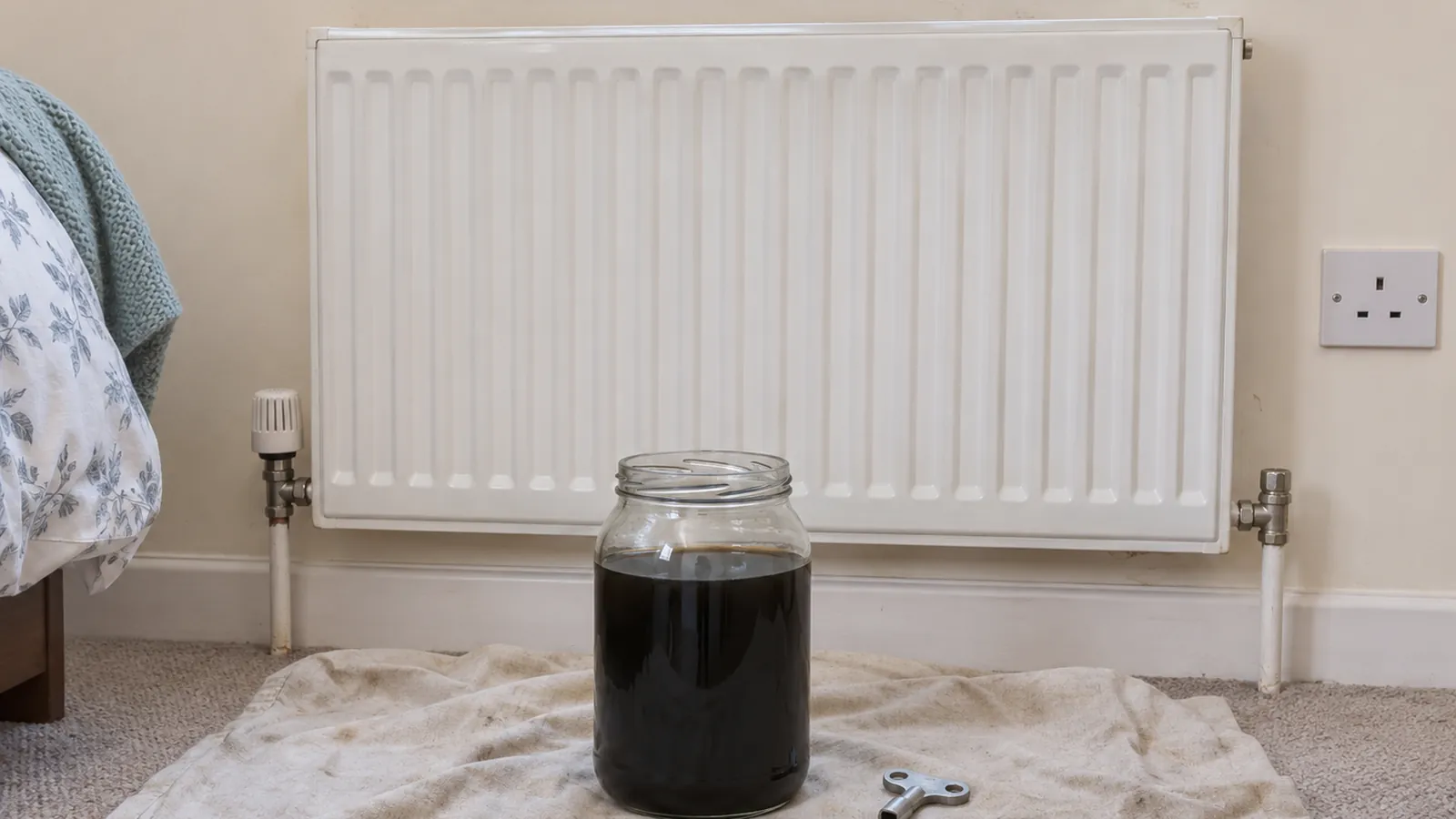
Black sludge from corrosion collects at the bottom of radiators, and towel rail tubes are narrow enough to block. The sign is a cold bottom and a warm top, or cold patches in the vertical tubes.
A heating engineer can do a chemical clean or a power flush, and fit a magnetic filter so it doesn't come straight back. See power flush cost for the price range. Costs vary by area and system size, but 2026 estimates for a chemical flush or power flush typically run from a few hundred pounds to over £500, and a magnetic filter fitted separately is often £100 to £250. Those are rough figures, so get quotes.
Sludge is rarely confined to one rail. If one is blocked, others are probably on their way.
Wrong pipework
Occasionally a rail never worked well because of how it was plumbed.
- On the hot water circuit only. Heats only when the cylinder is heated.
- Connected to a pipe that's too small, or a long single-pipe run.
- Fitted with the flow and return reversed. Many towel rails work either way, but some don't.
- Fitted with a tight air pocket and no way of bleeding it, because the bleed valve is blanked off or hidden.
If you suspect the pipework, a plumber needs to look at it. It's not a householder fix.
Dual fuel and electric towel rails
A dual fuel rail has a T-piece at the bottom and an electric element, so it heats from the central heating in winter and from the element when the heating is off. They fail in two ways: the water side and the electric side.
Never switch on an electric element unless the rail is completely full of water. An element running dry or in a drained rail can burn out and can damage the rail. Bathrooms also have electrical zones, and anything fixed, wired or replaced there is for a qualified electrician.
- Test each side separately. Turn the element off and check the rail warms from the heating. Then, in summer or with the heating off, turn the element on and see if it warms.
- Warm on the heating but dead on the element: check the element's switch, the spur or timer, and the thermostat setting. Failed elements and wiring faults are an electrician's job.
- Warm on the element but cold on the heating: it's one of the water side causes above. The element sits near the bottom, so water around it heats, but the top may stay cold if air is trapped above. Bleed it with the element off.
- Element warm only at the bottom: normal for thermostatic elements that cut out early, but air in the upper section can make it worse.
A pure electric rail (no pipework) is different. If the rail is filled with thermal fluid and the element is warm but the bars are cold, or nothing happens at all, it's a replacement part or a call to the manufacturer.
When to call a heating engineer
- Bleeding and valve checks haven't helped, and the rail stays cool.
- Several radiators have the same cold-bottom pattern (sludge).
- The pressure keeps falling, or the rail leaks at a valve.
- The boiler itself is locking out. If you have a Worcester, see how to reset a Worcester boiler.
- You need to drain the system, fit a T-piece, or move pipework.
Costs vary by region and company. A call-out and diagnosis is often in the £60 to £120 range, a valve replacement often a little over that, and a full balance can cost more. Treat all of those as rough 2026 estimates.
Snap a photo of the valves and the rail connections before you call. It helps an engineer say on the phone whether it's a quick job.
FAQs
Why is my heated towel rail cold at the top?
Almost always air. Bleed it from the valve at the top with the heating off and the rail cool.
Why is my towel rail only lukewarm?
Possible reasons: partly closed lockshield, poor balancing, sludge, or a chrome rail whose output is just lower than a white one. Check the BTU against the room.
Why does my towel rail only get hot when the hot water is on?
It may be plumbed to the hot water circuit, not the heating. A plumber can reroute it, though it isn't always practical.
Why is my dual fuel towel rail not heating?
Test the heating side and the element separately. If the element side is dead, it's an electrician's job. If the heating side is cold, bleed the rail and check valves.
Can I run the electric element if the rail is empty?
No. Running an element without water can destroy it. Make sure the rail is full and bled first.
Is a chrome towel rail less effective than white?
Usually yes. Chrome gives out less heat than a painted rail of the same size, so check the BTU figures.
Can I fix a towel rail myself?
Bleeding and checking valves, yes. Drain-downs, element wiring and pipework changes are for a plumber or electrician.
- Cold top: bleed it. Cold all over: check valves and the TRV pin.
- Chrome rails give out less heat than white ones, so check the BTU.
- Cold bottom means sludge. Get it flushed and fit a magnetic filter.
- Dual fuel: never run the element on an empty rail, and leave wiring to an electrician.